The biggest finance mistake an Indian founder makes is not whom they hire — it's when. Hire too early and you'll burn ₹1 Cr+ on a senior CFO who has nothing to do for nine months. Hire too late and you'll spend the next year cleaning up cash flow gaps, missed GST filings, and a board that's lost confidence in your numbers.
Most founders ask, "Do I need a CFO?" The better question is: "What signal am I waiting for?"
This guide is the framework we use with 100+ Indian business owners every year — not a list of generic stages, but the actual cash flow, fundraising, audit, and complexity triggers that tell you the math has shifted. You'll get the 10 signals, the stage map, the self-assessment scorecard, the cost-of-waiting calculation, and the honest answer to "Hire, outsource, or wait?"
When Is the Right Time to Hire a CFO?
For most Indian companies in 2026, the right time to hire a CFO (in any model — fractional, outsourced, or full-time) is when at least three of the following are true:
- Annual revenue is ₹5 Cr+ and growing 50%+ YoY
- Cash runway has dipped under 9 months at any point in the past year
- You're 6–9 months from a fundraise (Seed, Series A, or beyond)
- Statutory or tax compliance has slipped (GST notice, late TDS, missed advance tax)
- The founder is spending more than 5 hours a week on financial operations
- Your monthly close takes more than 15 days
- Working capital is consistently tight despite "profitable" P&L
- You've expanded to multi-state, multi-entity, or multi-currency operations
- You're preparing for an audit, due diligence, or M&A discussion
- The board is asking questions the founder can't answer in 60 seconds
If fewer than three are true, you probably don't need a full-time CFO yet — but you may need a fractional or outsourced one. (Once you've decided when, our earlier framework on part-time vs full-time vs fractional CFO answers the which.)
Why "When" Matters More Than "Which" — The Cost of a Wrong-Time Hire
Founders obsess over fractional vs full-time. Investors obsess over CFO timing. Here's why:
| Wrong-Time Decision | Typical Cost (Year 1) | Hidden Cost |
|---|---|---|
| Hired full-time CFO too early | ₹80L – ₹1.5 Cr in salary + equity | 6–9 months of management time + replacement risk |
| Waited too long, finance broke | ₹40L – ₹1 Cr in penalties, interest, missed deals | A failed fundraise or strained investor relationship |
| Hired the wrong model (e.g., Full Time when fractional CFO was right) | 2–3x the optimal cost | Founder still doing the work the CFO should own |
| Picked a low-cost "CFO" that was a glorified accountant | ₹5L – ₹10L | Books still messy, no FP&A;, board pack absent |
The economics are clear: timing is a higher-leverage decision than the model.
Cash Flow & Business Signals That Say It's Time
Use this checklist with your last quarter's data. If three or more match, the hire window is open
| # | Signal | What It Looks Like in Real Life |
|---|---|---|
| 1 | Cash runway under 9 months | "We had to push payroll by 5 days twice this year." |
| 2 | DSO over 75 days | Receivables stretching, customers slow-paying, GST paid before cash collected. |
| 3 | Profitable P&L, tight cash | "We made ₹3 Cr last year, but I have ₹40L in the bank." |
| 4 | Compliance slip | A GST notice, late TDS, MCA fine, or missed advance tax. |
| 5 | Multi-state or multi-entity ops | India + Singapore, or Pvt Ltd + LLP, or 5+ GST registrations. |
| 6 | Pricing decisions stalled | "We don't actually know our gross margin per product." |
| 7 | Fundraise in 6–9 months | A real round, not "exploring conversations." |
| 8 | MIS arrives 25+ days late | "We saw March numbers in late April. Then we fixed two of them in May." |
| 9 | Founder is the FP&A | The CEO is building the model, the budget, and the board pack alone. |
| 10 | Board has lost confidence in numbers | "Are these numbers right?" is asked in two consecutive board meetings. |
If three or more match, you're past the "can wait" stage. Our 7 Common Cash Flow Mistakes Indian Startups Must avoid maps directly to triggers 1, 2, 3, and 8 — the cash-flow cluster of signals.
Stage-by-Stage CFO Hiring Map (By Revenue and Round)
A practical framework for Hiring CFO for business in 2026:
| Stage | Annual Revenue | What Finance Looks Like | Right CFO Model |
|---|---|---|---|
| Pre-Revenue / Pre-Seed | ₹0 – ₹2 Cr | A founder + a CA partner | No CFO yet |
| Seed | ₹1 Cr – ₹5 Cr | Bookkeeper + CA + a 13-week cash forecast | Fractional CFO (8–12 hrs/wk), especially around fundraise |
| Series A | ₹5 Cr – ₹50 Cr | Finance manager + CFO oversight | Fractional or Outsourced CFO |
| Series B | ₹50 Cr – ₹125 Cr | 2–4 person finance team | Outsourced CFO with team, OR begin full-time CFO search |
| Series C+ | ₹125 Cr – ₹200 Cr | 5–10 person finance org | Full-time CFO (mandatory) |
| Pre-IPO / Late Stage | ₹200 Cr+ | Group CFO + 10–20 person team | Full-time Group CFO |
The biggest timing mistake — separate from the model mistake — is waiting until Series A is well underway before bringing in any CFO. The board pack, financial model, and data room should be CFO-grade before the first investor call, not after.
Cash Flow Triggers That Demand a CFO (Not Just an Accountant)
This is the heart of the topic — and where most founders get the diagnosis wrong.
An accountant looks backward. They close the books, file returns, and reconcile. A CFO looks forward. They model cash, force pricing decisions, push collections, and keep the business solvent.
If you have any of these, an accountant is no longer enough:
- A 13-week rolling cash forecast that no one is maintaining
- Receivables ageing that's drifting (more than 25% over 60 days)
- A cash conversion cycle longer than your gross margin can absorb
- Working capital lines that need negotiation with banks, not just renewal
- Multi-currency exposure that hits you on every quarterly close
- Inventory or WIP that's ballooning faster than revenue
- A GST refund stuck for months that no one is chasing
- Vendor payment cycles that are longer than your customer cycles (negative working capital trap)
Each of these is a CFO problem, not a bookkeeping problem. (Our Cash Flow Management: A Practical Guide for Indian Businesses covers the operating playbook for these exact issues.)
The CFO Self-Assessment Scorecard
Score your business honestly. Each "No" is a point.
| Question | Yes | No |
|---|---|---|
| Do you close the books within 10 working days every month? | 0 | 1 |
| Do you have a board-ready MIS pack within 15 working days of month-end? | 0 | 1 |
| Do you have a 13-week rolling cash forecast updated weekly? | 0 | 1 |
| Do you know your gross margin by product line and customer cohort? | 0 | 1 |
| Are advance tax instalments paid in line with forecasted profit? | 0 | 1 |
| Have you had zero compliance notices (GST/TDS/ROC) in the last 12 months? | 0 | 1 |
| Do you have an annual budget with three scenarios (base/best/worst)? | 0 | 1 |
| Is the founder spending less than 3 hours a week on finance operations? | 0 | 1 |
| Is your cap table reconciled to ROC and FC-GPR filings? | 0 | 1 |
| Can you produce a clean data room within 5 working days for a diligence ask? | 0 | 1 |
Scoring
- 0–2: Healthy. Hold off; revisit in 6 months.
- 3–4: Engage a fractional CFO for ~10 hrs/week, output-focused.
- 5–7: Outsourced CFO with a delivery team is the optimal economic choice.
- 8–10: You're past due. Hire a CFO this quarter. If revenue justifies it, start the full-time search; otherwise, a senior outsourced model bridges the gap fastest.
Why Founders Wait Too Long (and Why It Costs Them)
The most common reasons we hear (and the real cost):
- "We can't afford one yet." A ₹10L outsourced CFO engagement is cheaper than the ₹80L+ in compliance penalties, lost deals, and refinancing surprises that arrive without one.
- "My CA does it." A CA closes books and files returns. They don't run FP&A, fundraise, treasury, transfer pricing, or scenario modelling. Different roles.
- "I'm the CFO for now." True for ₹0–2 Cr. By ₹10 Cr, this assumption has cost the founder 8–10 hours a week on the wrong work.
- "We'll hire when we close the round." Investors decide before the round. A clean board pack and an 18-month forecast are what unlock the round — not what you build after it.
- "We'll see how Q4 goes." Q4 won't decide it. The state of your books on the day of diligence will be
Why Founders Hire Too Early (and Why It Costs Them More)
The opposite mistake – and a more expensive one:
- Hiring a ₹1 Cr+ CTC CFO at Series A. They have nothing to do for 6 months and leave inside a year.
- Hiring an ex-Big-4 partner with no startup ops experience. Process-heavy, decision-light. The team builds spreadsheets, not pipelines.
- Giving 2%+ equity to a wrong-fit hire. The replacement costs are dilutive and emotional.
- Skipping the fractional/outsourced step entirely. You miss 12–18 months of accumulated learning that would have shaped a much better full-time JD.
The cleanest path: fractional or outsourced first, full-time when complexity demands it.
How to Decide: Hire, Outsource, or Wait
A simple decision tree:
| Your Situation | Right Move |
|---|---|
| Fewer than 3 trigger signals + no fundraise in 12 months | Wait. Strengthen bookkeeping and CA support. |
| 3–5 trigger signals + no immediate fundraise | Hire a Fractional CFO (10–15 hrs/week, output-driven). |
| 3–5 trigger signals + fundraise in 6–9 months | Engage Outsourced CFO (firm-led, with delivery team). |
| 5+ trigger signals + active fundraise / audit | Outsourced CFO immediately + start scoping full-time hire. |
| 7+ trigger signals + Series B+ stage | Full-time CFO search this quarter. |
This is the same decision tree we walk through with founders in our 30-minute consultations — and it filters out the "wait" cases honestly. Not every business needs a CFO this year.
For a deeper view on what a senior fractional or outsourced CFO actually does day-to-day, see our What a Fractional CFO Actually Does (Beyond the Numbers).
What to Expect in the First 90 Days With a CFO
A good CFO — fractional, outsourced, or full-time — will deliver in the first 90 days the following:
| Deliverable | Why it matters |
|---|---|
| 13-week rolling cash forecast | Gives real-time runway visibility instead of month-end surprises |
| Monthly board-ready MIS pack | Standardizes reporting for investors and internal decisions |
| 12-month rolling forecast | Sets the planning horizon beyond just cash |
| Chart of accounts, audit-ready | Removes a major blocker at fundraise or audit time |
| Top-5 financial risks, documented with mitigation | Converts vague worry into a tracked action list |
| Cap table reconciliation | Catches equity/dilution errors before they reach a term sheet |
| GST/tax compliance certification | Confirms no compliance debt is hiding in the transition |
If your CFO hasn't shipped these in 90 days, you don't have a CFO — you have an expensive consultant.
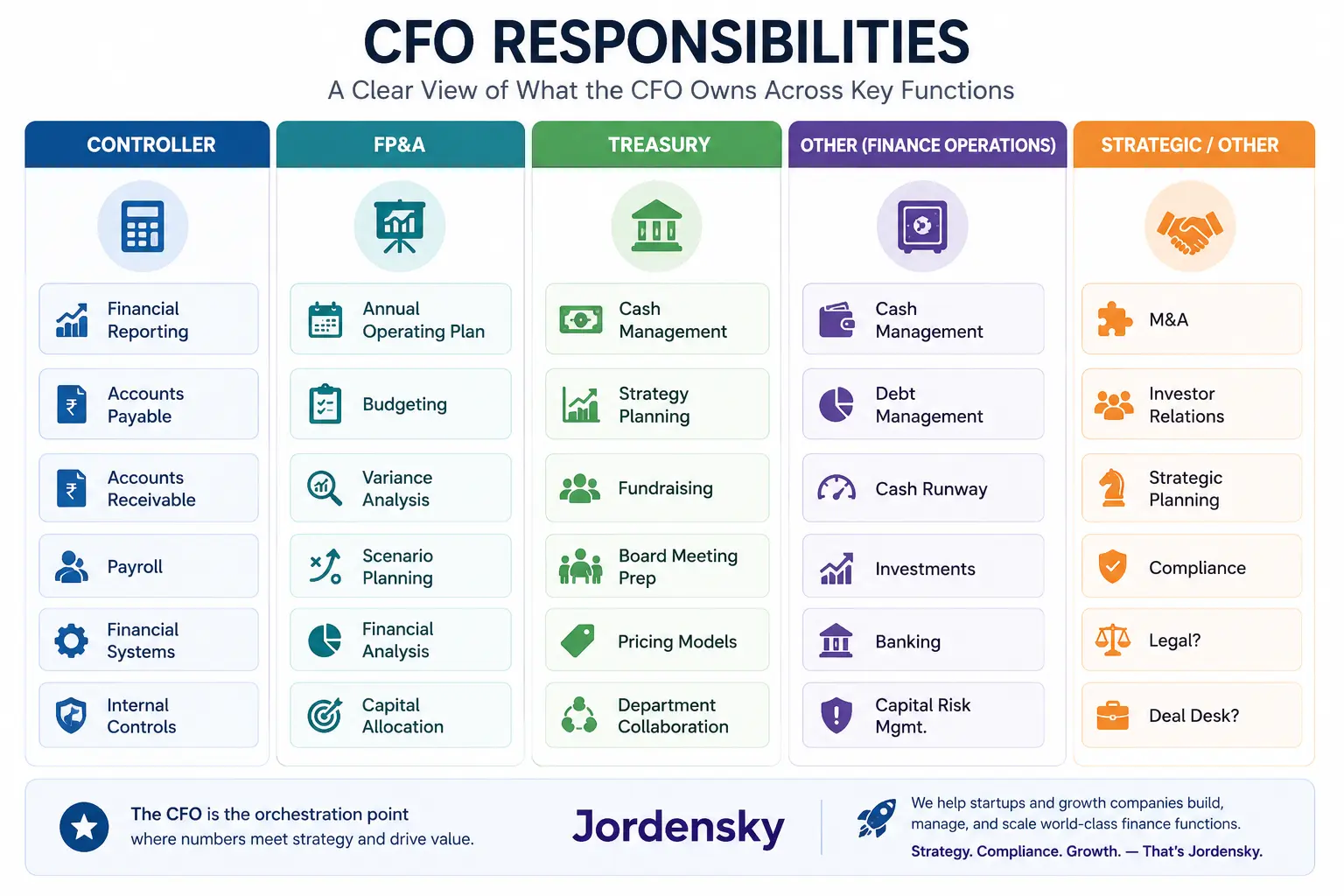
Role and Responsibilities of CFO
Expert Tips From a Practising CFO
- Run the trigger checklist quarterly, not annually. Triggers move faster than founders realise.
- Treat the first CFO engagement as the foundation, not the final answer. A great fractional CFO designs the role you'll eventually hire full-time into.
- Define success in 90-day blocks. Forecast accuracy ±5%, 10-day close, audit-ready data room.
- Don't outsource finance and avoid it. A CFO is a force multiplier if the founder shows up to weekly reviews.
- Anchor decisions to cash, not P&L. Profit is an opinion; cash is a fact.
- Build the board pack before the board asks for it. A self-imposed monthly deadline lifts every other discipline.
- Tie CFO compensation to outcomes. Forecast accuracy, audit cleanliness, and fundraising velocity. Numbers, not hours.
Common Mistakes in Timing the CFO Hire
- Reading "founder time on finance" as a vanity metric. It's the single best leading indicator that you've over-extended.
- Waiting for "more clarity". A CFO creates the clarity. Waiting compounds the problem.
- Confusing "we have a CA" with "we have a CFO. "Different roles, different outputs.
- Hiring during a crisis. A panicked hire under fundraising pressure is the worst possible context.
- Picking on price alone. A ₹50K/month "CFO" is almost always a glorified accountant in CFO clothing.
- No KPIs in the engagement letter. Output undefined = output undelivered.
- Reporting CFO to CRO or COO. A CFO must report to the CEO. Period.
Wondering whether it's time to hire a CFO? Jordensky's Virtual CFO practice has helped 100+ Indian founders make this decision — fractional, outsourced, or full-time. We'll run the trigger checklist with you, audit your finance maturity, and recommend the right model (and named CFO) for your next 18 months.
Talk to a Virtual CFO → 30-minute consultation. No commitment. CFO-level insights, not a sales pitch.
Frequently Asked Questions
1. When should a startup hire a CFO?
When at least three trigger signals are true: revenue above ₹5 Cr, cash runway under 9 months, an upcoming fundraise within 6–9 months, compliance slips, or the founder is spending more than 5 hours a week on finance. Most startups should engage a fractional or outsourced CFO at this point — not a full-time hire.
2. Is it too early to hire a CFO at the seed stage?
A full-time CFO is almost always too early at Seed. A fractional CFO (8–12 hours per week) is often the right move from Seed onwards — especially when preparing for a Series A fundraise.
3. Can I just rely on my CA instead of hiring a CFO?
A chartered accountant focuses on compliance and historical reporting. A CFO is forward-looking — they own FP&A, cash flow, fundraising, treasury, and strategic finance. Both roles are needed; one cannot substitute for the other.
4. How much does it cost to hire a CFO in India in 2026?
A full-time CFO costs ₹80L – ₹3.5 Cr CTC + equity. A fractional CFO costs ₹1.0L – ₹1.5L per month. An outsourced CFO with a delivery team costs ₹1.25L – ₹2L per month. Choose based on stage and the deliverables you actually need.
5. What are the top signs I need a CFO right now?
Cash runway under 9 months, DSO above 75 days, late or missed compliance filings, a fundraise within 9 months, a monthly close that takes more than 15 days, and a founder spending 5+ hours per week on finance. Three or more = the hire window is open.
6. How long does it take to hire a CFO?
A full-time CFO search typically takes 3–9 months. A fractional or outsourced CFO can be onboarded in 1–3 weeks. This is a major reason most early-stage Indian companies start with a fractional or outsourced model.
7. What should a CFO deliver in the first 90 days?
A 13-week cash forecast, a clean monthly board pack, a 12-month rolling forecast, an audit-ready chart of accounts, and a documented list of the top 5 financial risks with mitigation plans.
8. Should the CFO report to the CEO or the COO?
Always to the CEO. A CFO reporting to the COO weakens governance and creates conflicts of interest in financial reporting and investor relations.
9. When should I switch from a fractional CFO to a full-time CFO?
Typically when you cross ₹75–100 Cr ARR or are 12–18 months from a Series C or pre-IPO milestone. Below that, a fractional or outsourced model is usually more economical and faster to scale.
10. Can a CFO help fix cash flow problems?
Yes — fixing cash flow is one of the highest-value things a CFO does. They build a 13-week rolling forecast, tighten DSO, restructure working capital lines, and align tax instalments with cash availability. For most SMEs, this alone pays for the CFO engagement.
Final Takeaway — A CFO Is a Lever, Not a Luxury
Hiring a CFO is not a status decision; it's a leverage decision. The right CFO, hired at the right time, in the right model, makes every other decision in the business cheaper and faster – pricing, hiring, fundraising, compliance, and exit. The wrong-time hire (early or late) compounds in the opposite direction.
Run the trigger checklist this week. If three or more match, the hire window is open. Start with a fractional or outsourced model, define 90-day deliverables, and graduate to full-time when complexity demands it. That's the framework. Everything else is a detail.