The wrong CFO hire will cost you a year — sometimes two. Founders either over-hire (a ₹1 Cr+ CTC full-time CFO at a Series A that needed a fractional CFO) or under-hire (a part-time bookkeeper at a Series C that desperately needed a real Group CFO). Both mistakes cost the same: missed forecasts, failed fundraises, and a board that loses confidence.
In 2026, founders have three serious options — full-time, part-time, and fractional CFOs — and a fourth, virtual/outsourced, that confuses everyone. The differences are not academic. They drive cost, control, capability, and credibility with your board and investors.
This guide is the framework we use with 100+ founders every year. You'll get the side-by-side comparison, India 2026 cost benchmarks, the stage-by-stage hiring map, and the questions that separate a great fractional CFO from an expensive consultant in a finance jacket.
Which CFO Do You Actually Need?
For most Indian companies in 2026, the rule of thumb looks like this:
| Annual Revenue | Recommended CFO Model |
|---|---|
| Under ₹5 Cr | Strong Finance Manager + CA partner (no CFO yet) |
| ₹5 Cr – ₹25 Cr | Fractional CFO (8–15 hours/week) |
| ₹25 Cr – ₹100 Cr | Part-Time CFO or senior Fractional (2–3 days/week) |
| ₹100 Cr – ₹300 Cr | Full-Time CFO (in-house) |
| ₹300 Cr+ | Full-Time Group CFO + finance team of 8–15 |
Stage and complexity matter as much as revenue. A pre-revenue, deep-tech startup raising a $20M Series A will need a fractional CFO long before a ₹50 Cr profitable D2C brand does.
What Each CFO Model Really Means
Full-Time CFO
A senior in-house executive, typically a Chartered Accountant (CA), CFA, or MBA with 12–25 years of experience. Reports to the CEO. Owns finance, FP&A, treasury, tax, audit, investor relations, and often legal. CTC in India ranges from ₹60 lakh to ₹1.5 Cr+ depending on stage and equity.
Part-Time CFO
A senior CFO who commits 2–3 fixed days a week to one company, often as the only senior finance leader. Common for ₹25–100 Cr companies that need CFO-level depth but not 5 days a week. Engagement is exclusive (the CFO usually works with only 1–2 companies at a time).
Fractional CFO
A senior CFO who works across multiple companies simultaneously, typically 8–20 hours per company per week. Engagements are output-driven (board pack, fundraising, FP&A build, and tax planning) rather than presence-driven. Sweet spot for early- and growth-stage startups.
Virtual / Outsourced CFO (and How It Differs)
A team-based engagement — usually delivered by a CFO advisory firm (like Jordensky) — where a senior CFO supervises a team of analysts, accountants, and FP&A associates who execute the work. You get senior judgement and execution capacity for the price of a single hire. This is the fastest-growing model in India in 2026.
The simple test: Fractional CFO = one senior person, your share of their time. Outsourced CFO = a senior person plus a team delivering the output.
Part-Time vs Full-Time vs Fractional CFO — Side-by-Side Comparison
| Dimension | Full-Time CFO | Part-Time CFO | Fractional CFO | Virtual / Outsourced CFO |
|---|---|---|---|---|
| Time commitment | 5 days / week | 2–3 days / week (1 client) | 8–20 hrs / week (multiple clients) | Team-based, scoped per deliverable |
| Best for | ₹200 Cr+ revenue or pre-IPO | ₹25–100 Cr or active fundraise | ₹10–100 Cr or seed–Series B | ₹3–100 Cr seeking depth + execution |
| Speed to onboard | 3–9 months | 4–8 weeks | 1–3 weeks | 1–2 weeks |
| Equity expectation | 0.5%–3% common | Sometimes (small grant) | Rare | None |
The most common mistake we see: founders comparing fractional vs full-time when they should be comparing fractional vs outsourced. The cost is similar; the leverage is very different.
How Much Does Each CFO Model Cost in India?
Real-world ranges from 100+ engagements we run and benchmark every year:
| CFO Model | Monthly Cost (₹) | Annual Cost (₹) | What's Typically Included |
|---|---|---|---|
| Full-Time CFO (Series A/B startup) | ₹8L – ₹15L | ₹1 Cr – ₹1.8 Cr + equity | Full ownership, no team unless you fund it |
| Full-Time CFO (Series C+ / ₹300 Cr+) | ₹15L – ₹30L+ | ₹2 Cr – ₹3.5 Cr+ + equity | Full ownership + team of 5–15 |
| Part-Time CFO | ₹6L – ₹18L | ₹72L – ₹2.16 Cr | 2–3 days/week, no embedded team |
| Fractional CFO (independent) | ₹1.5L – ₹6L | ₹18L – ₹72L | Senior judgement only, ~10–15 hrs/week |
| Virtual / Outsourced CFO (firm-led) | ₹1.25L – ₹5L | ₹15L – ₹60L | Named senior CFO + analysts + FP&A; team |
A clean way to think about it: a good outsourced CFO model gives you 70% of a full-time CFO's strategic value at 25–35% of the cost — plus a delivery team you wouldn't get from a solo fractional.
For a much deeper benchmark on this specifically, see our Startup CFO Services Cost in India: The Definitive 2026 Guide.
CFO Responsibilities — What Should You Actually Expect?
Not every CFO does every job. Here's what typically falls under each model:
| Responsibility | Full-Time CFO | Part-Time CFO | Fractional CFO | Outsourced CFO (firm) |
|---|---|---|---|---|
| Strategic finance & FP&A; | ✅ | ✅ | ✅ | ✅ |
| Fundraising support / investor relations | ✅ | ✅ | ✅ (limited) | ✅ |
| Board pack & MIS | ✅ | ✅ | ✅ | ✅ |
| Treasury & cash management | ✅ | ✅ | ✅ | ✅ |
| Tax planning & compliance | ✅ | ✅ | Sometimes | ✅ (with team) |
| Audit liaison | ✅ | ✅ | Sometimes | ✅ |
| Bookkeeping & accounting ops | ❌ (delegates) | ❌ (delegates) | ❌ | ✅ (team executes) |
| Hiring & managing finance team | ✅ | ✅ | ❌ | ✅ (provides team) |
If you need a CFO who only gives strategic input and hands the work to your team, fractional is fine. If your team can't execute, an outsourced model is almost always the better economic choice.
When to Hire Each Type of CFO (By Stage and Revenue)
A practical map we share with founders:
- Pre-Revenue / Pre-Seed: Don't hire a CFO. Get a strong CA + a finance manager. Spend money on products, not titles.
- Seed (₹1–5 Cr ARR): Hire a fractional CFO for fundraising prep, financial model, and the first board pack.
- Series A (₹5–25 Cr ARR): Fractional or outsourced CFO is the sweet spot. You need senior judgement weekly, but a full-time CFO is overkill.
- Series B (₹25–75 Cr ARR): An outsourced CFO with a strong delivery team, or a part-time CFO if you have your own team. Begin scoping a future full-time hire.
- Series C (₹75–200 Cr ARR): Full-time CFO, ideally one who's been through an exit or IPO. The complexity (multi-entity, debt, working capital, ESOP, and secondary) needs full ownership.
- Pre-IPO / Late Stage (₹200 Cr+): Full-time Group CFO with a 10–20 person finance org.
The biggest hiring mistake we see is founders skipping the fractional/outsourced step and going straight to a full-time CFO at Series A. They burn ₹1 crore+ on the wrong hire and lose 9–12 months replacing them.
Why This Decision Matters More in 2026
Three forces are reshaping CFO hiring in India in 2026:
- Capital is selective. With longer fundraising cycles, every founder needs a CFO-quality story — but not every founder can afford a full-time CFO. Fractional and outsourced models have become the default for seed-to-Series B.
- Tax and compliance complexity is rising. GST, TDS, advance tax, ESOP taxation, transfer pricing, and global structuring (especially for India-Singapore-Delaware setups) demand CFO-level oversight. (Our Cash Flow Management: A Practical Guide for Indian Businesses walks through the cash side of this.)
- AI is reshaping finance work. A modern outsourced CFO team uses AI-driven close, automated MIS, and forecasting tools — which means a 4-person external team can match a 10-person internal one in 2026. The economics of in-house finance are shifting fast.
In short, in 2026, the question isn't "Do I need a CFO?" — it's "Which CFO model gets me the most leverage at this stage?"
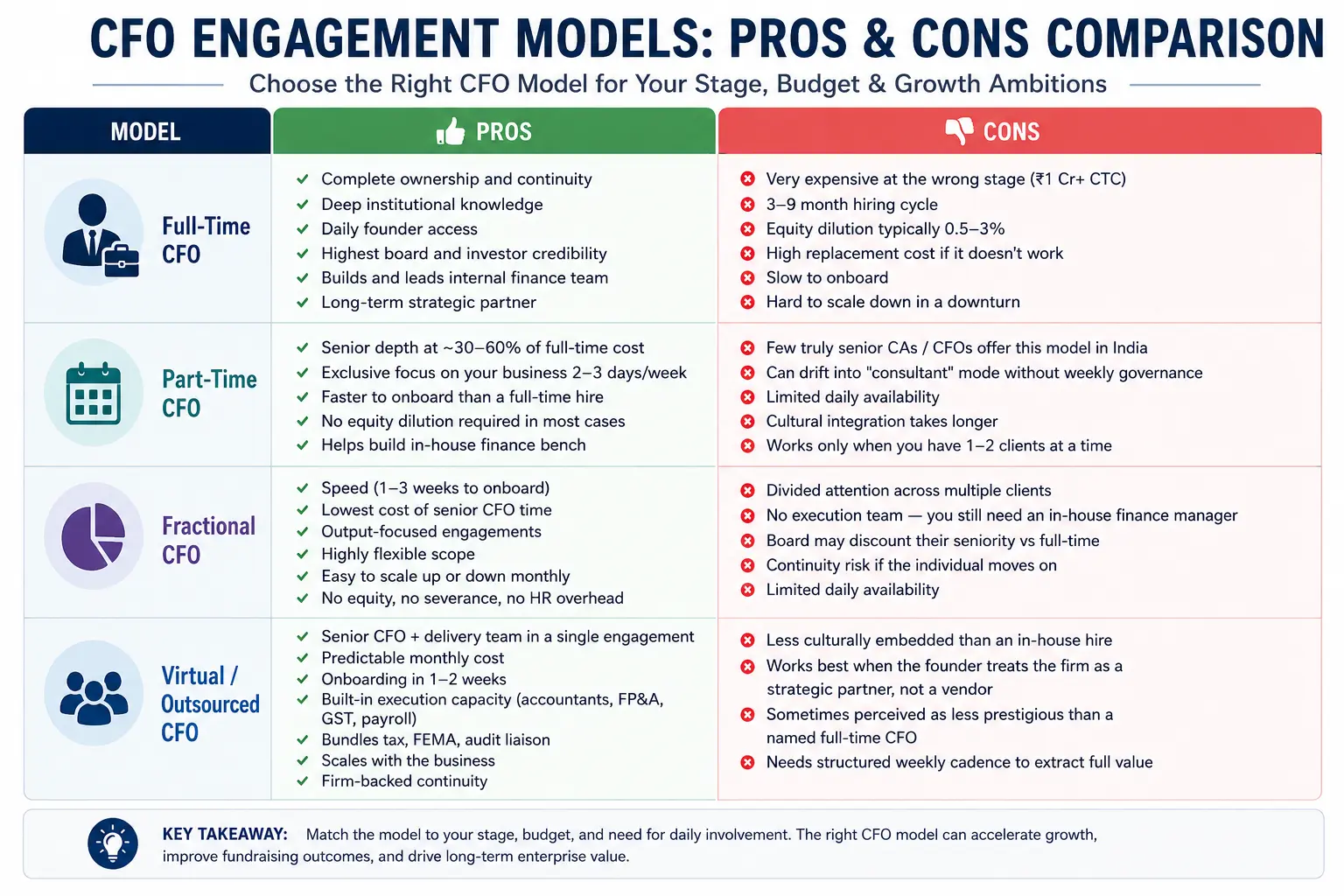
Pros an Cons of Each CFO Model
How to Choose the Right CFO — Step-by-Step
- Define the next 18 months, not the next 5 years. Hire for the actual problems you'll face – fundraising, GTM expansion, audit, tax, ESOP, and exit. Not for "strategic finance" in the abstract.
- Audit your finance maturity. Do you have books closed by Day 10? A board pack? A 13-week cash forecast? If not, you need execution capacity (outsourced) before you need pure strategy (fractional).
- Calculate your CFO budget honestly. A real full-time CFO in India in 2026 is a ₹1 Cr+ all-in commitment. If that's >5% of your revenue, you don't need a full-time CFO yet.
- Decide: judgement-only or judgement + execution? This single question separates fractional from outsourced.
- Run a 60-day trial. With fractional and outsourced models, trial the engagement before committing for 12 months.
- Define success metrics upfront. Forecast accuracy, audit-readiness, fundraising outcomes, and MIS quality. CFOs without KPIs become consultants.
- Plan the transition. Even a great fractional engagement should have a 12–24 month succession plan to a full-time CFO if you're scaling fast.
For the financial planning groundwork that any incoming CFO will expect to see, our Startup Financial Planning: CFO-Level Strategy on a Budget is the right primer.
Common Hiring Mistakes Founders Make
- Hiring a full-time CFO too early. A ₹15 Cr ARR startup almost never needs one.
- Hiring an "audit CA" as CFO. Statutory audit experience and CFO experience are different jobs. Don't confuse them.
- Picking the cheapest fractional CFO. ₹50K/month "CFOs" usually deliver bookkeeping with a fancy title.
- No scope of work. Without a written deliverables list, every engagement drifts.
- Reporting CFO to COO or CRO. A real CFO must report to the CEO. Anything else creates conflict and weakens governance.
- Skipping the trial period. A 60–90 day trial saves you from a 12-month mistake.
- Confusing presence with productivity. A great fractional CFO who delivers a board-ready model in 2 weeks is worth more than a full-timer who's "always around".
- Not benchmarking cost. Founders often pay ₹2 Cr CTC for a CFO when an outsourced model would have been ₹40L for similar output.
Red Flags When Hiring a Fractional or Part-Time CFO
- They quote a fixed monthly fee but won't define deliverables
- They've never actually closed a fundraise or led an audit
- They don't ask for your books, your model, or your tax filings in the first meeting
- They commit to "all of it" — strategy, execution, accounting, tax — for one low fee
- They have 10+ "current" clients (they're consultants, not fractional CFOs).
- They can't tell you what's wrong with your last board pack in 15 minutes
- They confuse "CFO" with "controller" or "accountant"
How to Transition From Fractional to Full-Time CFO
The smoothest path:
- Start with a fractional or outsourced CFO at Seed/Series A.
- At Series B / ₹100 Cr ARR, the fractional CFO helps you scope the full-time CFO role and write the JD.
- The fractional CFO interviews candidates alongside you. They're often the best filter you'll find.
- After the full-time CFO is hired, the fractional stays on for 60–90 days for handover and
- Then transitions to a board advisor.
This pattern alone has saved founders we work with from a ₹1 Cr+ mis-hire more than a few times.
Not sure which CFO model is right for your stage?
Jordensky's outsourced CFO practice has matched 100+ Indian founders with the right finance model – fractional, part-time, full-time, or hybrid. We'll audit your current finance maturity, benchmark your CFO spend, and recommend the model (and named CFO) that fits your next 18 months.
Book a Free CFO Consultation → 30-minute call with a senior CFO Partner. No commitment. CFO-level insights, not a sales pitch.
Frequently Asked Questions
1. What is the difference between a fractional CFO and a part-time CFO?
A part-time CFO works 2–3 days a week with a single company on an exclusive basis. A fractional CFO works with multiple companies simultaneously, typically 8–20 hours per company per week, output-focused.
2. How much does a fractional CFO cost in India in 2026?
Independent fractional CFOs in India charge ₹1.5L – ₹6L per month, depending on seniority, sector, and scope. Firm-led outsourced CFO models (with a team) range from ₹1.25L to ₹5L per month.
3. Do early-stage startups need a CFO?
Pre-revenue and pre-seed companies usually don't. From seed onwards (₹1–5 Cr ARR), a fractional or outsourced CFO becomes valuable—especially for fundraising and the first board pack.
4. Can a fractional CFO help with fundraising?
Yes — fundraising support is one of the highest-value use cases. A senior fractional CFO can build the model, prepare the data room, run investor calls, and lead diligence. Many founders close their best round with a fractional CFO, not a full-time hire.
5. What's the difference between a virtual CFO and a fractional CFO?
A fractional CFO is one senior person working part of their time on your business. A virtual / outsourced CFO is a senior CFO plus a team (analysts, accountants, and FP&A) delivering the output. Outsourced gives you both judgement and execution.
6. When should I switch from a fractional CFO to a full-time CFO?
Typically when you cross ₹100 Cr ARR or are 12–18 months from a Series C / pre-IPO milestone. Below that, a fractional or outsourced model is usually more economical.
7. Is a CA the same as a CFO?
No. A Chartered Accountant (CA) is a qualification; a CFO is a role. Many great CFOs are CAs, but not every CA has CFO-level experience in FP&A, fundraising, treasury, and strategy. Hire for the role, not the qualification alone.
8. Can a fractional CFO replace a full-time CFO permanently?
For companies under ₹100 Cr ARR with manageable complexity, yes. For larger or more complex businesses (multi-entity, regulated, pre-IPO), a full-time CFO eventually becomes necessary.
9. What should a CFO deliver in the first 90 days?
At minimum: a 13-week cash forecast, a clean monthly board pack, a 12-month rolling forecast, an audit-ready chart of accounts, and a clear list of the top 5 financial risks with mitigation plans.
10. How do I evaluate whether my current CFO is good?
Three questions: (1) Is forecast accuracy within ±5% at the EBITDA line? (2) Does the board pack arrive on time, every month, with insights? (3) Has the company avoided cash, tax, or audit surprises? Two yeses out of three is good. Three out of three is excellent.
Final Takeaway — Match the CFO to the Decision, Not the Title
The right CFO model is the one that solves the next 18 months of your business — at a cost your stage can afford. For most Indian companies between ₹5 Cr and ₹75 Cr in revenue in 2026, that's a fractional or outsourced CFO, not a full-time hire.
Don't romanticise the title. A great fractional CFO who delivers a Series A close is worth ten "full-time CFOs" who never get the model right. Match the model to the problem, define the deliverables, run a trial, and graduate to full-time when complexity demands it. That's how every well-run company we've ever worked with has scaled their finance function.