
For Australian founders, India in 2026 is the most accessible, most under-penetrated, and most regulated growth market within reach. The talent pool is six times Australia's. The cost base is 30–60% lower. The legal system is common-law and familiar. And — uniquely — the India-Australia ECTA (in force since December 2022) and the DTAA (in force since 1991, with the 2011 protocol) make the tax and tariff layer materially friendlier than for most other foreign founders.
But India still rewards structure, not speed. Get the entry vehicle, the DTAA-aligned tax posture, the FEMA reporting, and the AUD-INR repatriation flow right — and India prospers for the next decade. Get them wrong, and you'll spend 18 months unwinding mistakes that should never have happened.
This is the India Entry guide we run with every Australian founder before they spend an Australian dollar in India.
How an Australian Founder Sets Up Business in India
For most Australian companies entering India in 2026, the clearest path is the following:
- Choose an entry vehicle — a wholly-owned subsidiary (Pvt Ltd) is the default for 80%+ of cases.
- Confirm the FDI route — automatic for most sectors; government approval for sensitive ones (defence, telecom, media).
- Anchor the tax structure to the DTAA — model your withholding rates on dividends, royalties, fees for technical services (FTS), and interest before the first intercompany contract.
- Incorporate — reserve name (RUN/SPICe+ Part A), file SPICe+ Part B, and obtain CIN, GST, TAN, and IEC.
- Open an Indian bank account and infuse capital from the Australian parent in AUD or USD.
- File FEMA compliance (FC-GPR) within 30 days of share allotment.
- Set up tax, payroll, statutory compliance, and transfer pricing—TDS, GST, advance tax, EPFO, ESIC, and Form 3CEB—documentation from Day 1.
End-to-end timeline: 3–6 weeks if your structure is straightforward, 8–12 weeks with regulatory approvals.
Why India Is the Default Expansion Market for Australian Founders
Three trends are pulling Australian capital into India faster than ever:
- The India-Australia ECTA (Economic Cooperation and Trade Agreement) — in force since December 2022 — has cut tariffs on 96% of Australian exports to India and given Australian service providers (especially in tech, education, and professional services) easier access.
- Time zone advantage. With only a 4–5 hour overlap with India, Australian founders can run "follow-the-sun" operations across both markets – something US and European founders cannot.
- Common law and English-speaking talent. India and Australia share a British common law foundation. Contracts, IP, and dispute resolution work the way Australian founders expect — with substantially deeper bench strength in tech, finance, and operations.
The flip side: India rewards companies that respect structure. The penalties for getting FEMA, transfer pricing, or GST wrong are real — interest, prosecution, and, in extreme cases, restrictions on remittances back to Australia.
For day-to-day operating discipline once the entity is live, our Monthly Financial Review Checklist for Businesses is the right ongoing rhythm to install in the Indian entity from month one.
Entry Vehicles — Choosing the Right India Structure
| Vehicle | Australian Founder Use Case | Setup Time | Tax Rate (2026) |
|---|---|---|---|
| Wholly-Owned Subsidiary (Pvt Ltd) | Default — full operations, hiring, revenue, fundraising | 3–6 weeks | ~25.17% (Section 115BAA) |
| LLP | Light-asset services and consulting (where 100% automatic FDI applies) | 4–6 weeks | ~30%+ |
| Liaison Office | Market testing only; no revenue, no invoicing | 6–10 weeks (RBI) | N/A |
| Branch Office | Australian companies in trading/manufacturing wanting direct presence | 6–10 weeks (RBI) | ~43.68% |
| Project Office | Specific contracts (EPC, infrastructure) | 4–8 weeks (RBI) | ~43.68% |
| Joint Venture | Sectors with FDI caps (insurance, defense, multi-brand retail) | 6–12 weeks | ~25.17% |
For most Australian founders — especially in SaaS, fintech, ed-tech, services, and consumer brands — the wholly-owned subsidiary is the only sensible default. Branch and liaison offices have become rare.
India-Australia DTAA — The Tax Treaty That Decides Your Repatriation
The India-Australia Double Taxation Avoidance Agreement is the single most important document in your tax structure. It defines withholding rates on cross-border payments — and therefore decides how much of your Indian profit reaches Australia.
| Income Stream | Domestic India Rate | India-Australia DTAA Rate | What It Means |
|---|---|---|---|
| Dividends (post-DDT abolition) | 20% TDS | 15% | Indian sub pays dividend to Australian parent at 15% withholding |
| Interest (foreign loans) | 20% (with some 5% concessional rates) | 15% | Inter-company loans benefit from treaty rate |
| Royalties | 10% (concessional) | 10–15% | IP licensing from Aus parent to India sub |
| Fees for Technical Services (FTS) | 10% (concessional) | 10–15% | Tech / engineering services billed to India |
| Capital Gains (shares) | 10–20% | Per treaty + Indian rules | Exit / secondary sale of India entity |
Jordensky's Note: DTAA rates apply only when a valid Tax Residency Certificate (TRC) from the ATO is in place, along with Form 10F filed in India. Without these, the higher domestic rate applies — and recovering the difference is administratively painful.
Two Australian-specific implications:
- Australian franking credits do not flow through Indian dividends. The DTAA reduces Indian withholding, but the Australian franking system doesn't extend to Indian-sourced dividends.
- Permanent Establishment (PE) risk. If the Australian parent's directors operate the India entity day-to-day from Sydney or Melbourne (without local resident directors), Indian tax authorities may treat the Australian parent as having a PE in India — triggering Indian tax on worldwide income attributable to the PE.
This is why most Australia-India structures appoint a resident Indian director and document the place of effective management carefully.
India-Australia ECTA — How the Trade Agreement Helps You
The Economic Cooperation and Trade Agreement (ECTA), in force since 29 December 2022, is the practical reason Australian companies have an edge in India over US, UK, or EU founders today.
What ECTA does for you:
- Tariff elimination on 96% of Australian exports to India — including coal, alumina, sheep meat, wine, lobsters, and, importantly, many ICT and education-related services.
- Improved market access for Australian service providers — particularly in higher education, professional services, and ICT.
- Easier mobility for Australian professionals — student and intra-company transfer visas have been streamlined.
- The Comprehensive Economic Cooperation Agreement (CECA) is in active negotiation and expected to deepen these benefits further.
If your business model touches goods or services covered by ECTA, price the tariff and access advantage into your India go-to-market plan from day 1. It is one of the rare structural advantages a foreign founder gets in India in 2026.
Step-by-Step Incorporation for an Australian Founder
A clean 6-week path to a fully operational Indian subsidiary:
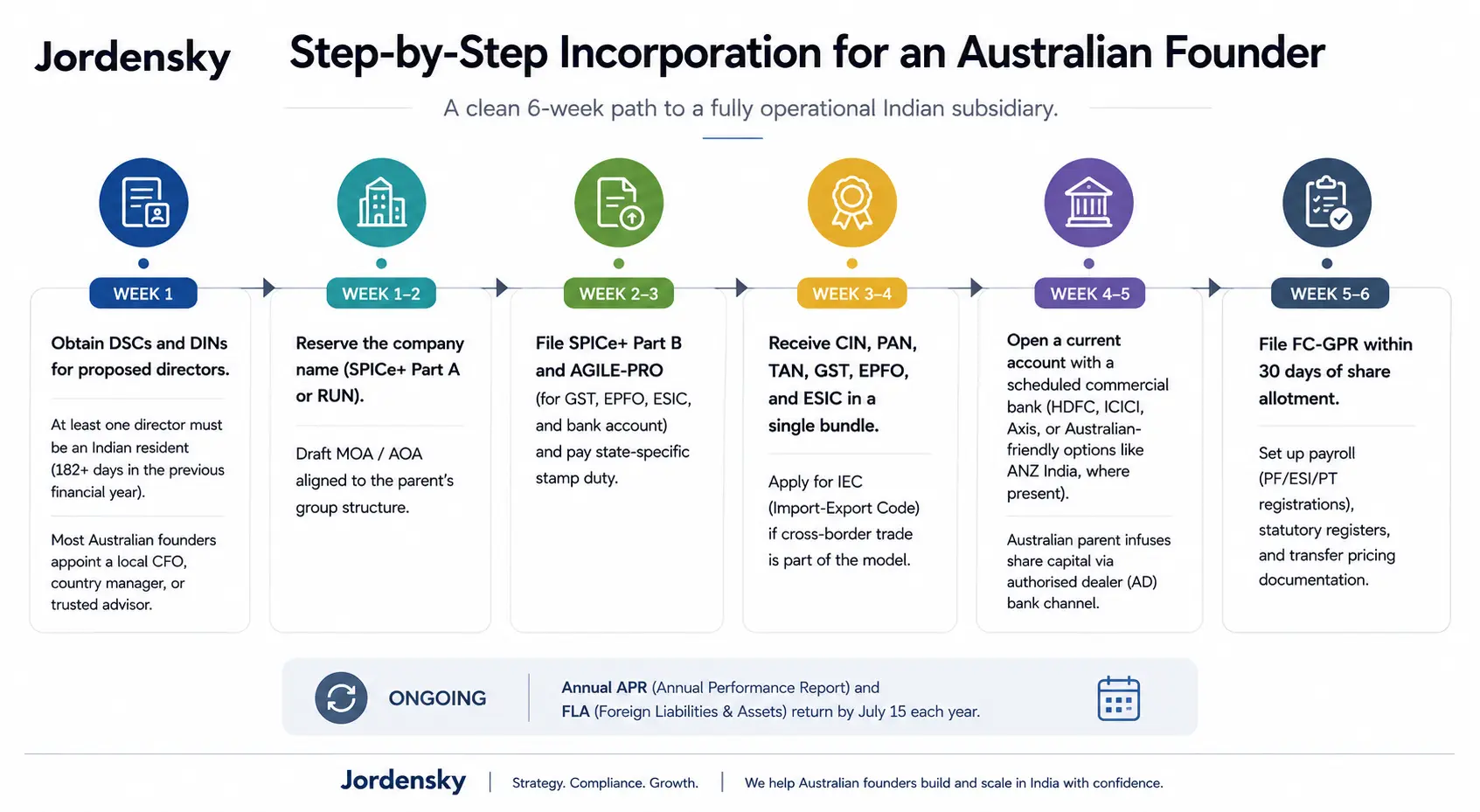
- Week 1: Obtain DSCs and DINs for proposed directors. At least one director must be an Indian resident (182+ days in the previous financial year). Most Australian founders appoint a local CFO, country manager, or trusted advisor.
- Week 1–2: Reserve the company name (SPICe+ Part A or RUN). Draft MOA / AOA aligned to the parent's group structure.
- Week 2–3: File SPICe+ Part B and AGILE-PRO (for GST, EPFO, ESIC, and bank account) and pay state-specific stamp duty.
- Week 3–4: Receive CIN, PAN, TAN, GST, EPFO, and ESIC in a single bundle. Apply for IEC (Import-Export Code) if cross-border trade is part of the model.
- Week 4–5: Open a current account with a scheduled commercial bank (HDFC, ICICI, Axis, or Australian-friendly options like ANZ India, where present). Australian parent infuses share capital via authorised dealer (AD) bank channel.
- Week 5–6: File FC-GPR within 30 days of share allotment. Set up payroll (PF/ESI/PT registrations), statutory registers, and transfer pricing documentation.
- Ongoing: Annual APR (Annual Performance Report) and FLA (Foreign Liabilities & Assets) return by July 15 each year.
For a deeper, India-domestic walkthrough of the same incorporation flow, see our Private Limited Registration Process in India: Step-by-Step Guide. Australian founders incorporating a wholly-owned subsidiary follow the same SPICe+ path, with the additional FEMA and DTAA layers on top.
Tax for Australian Founders Operating in India
The headline rates and obligations:
| Tax Item | Rate / Requirement (2026) | Frequency |
|---|---|---|
| Corporate income tax (Indian Pvt Ltd) | 22% (effective ~25.17% with surcharge & cess) under Section 115BAA | Annual + 4 advance tax instalments |
| Corporate tax (Aus parent direct PE) | 35% + surcharge & cess (~38–42% effective) | Annual |
| Dividend WHT to Australia (DTAA) | 15% (with valid TRC + Form 10F) | At payout |
| Interest WHT to Australia (DTAA) | 15% | At payout |
| Royalty / FTS WHT to Australia (DTAA) | 10–15% | At payout |
| GST | 0% / 5% / 12% / 18% / 28% | Monthly + annual |
| TDS on resident payments | 1–30% across sections | Monthly + quarterly returns |
| Payroll (PF, ESI, PT) | PF 12%, ESI 3.25% (employer) | Monthly |
| Transfer Pricing (Form 3CEB) | Mandatory for international related-party transactions | Annual |
| Equalisation Levy | 2% (where applicable for digital services) | Quarterly |
The transfer pricing piece is non-negotiable. Every Australian parent-Indian subsidiary transaction (royalty, management fee, SaaS licence, intra-group loan, and secondment cost) must satisfy the arm's-length principle, supported by a benchmarking study, and certified annually via Form 3CEB. Get this wrong and you invite a TP audit that takes 3–5 years to resolve.
FEMA, FC-GPR & Cross-Border Capital Movement
FEMA is the single most under-respected statute by Australian founders. Three filings to internalise:
| Filing | What It Captures | Deadline |
|---|---|---|
| FC-GPR (Foreign Currency – Gross Provisional Return) | Reports allotment of shares to non-resident (Australian) investors | Within 30 days of allotment |
| FLA Return (Foreign Liabilities & Assets) | Annual return on foreign holdings and liabilities | 15 July each year |
| APR (Annual Performance Report) | For Indian companies with overseas direct investment (ODI) | 31 December each year |
| 15CA / 15CB | Required for every overseas remittance (e.g., dividend, royalty to Aus) | Per remittance |
Late filings invite compounding penalties under FEMA—typically ₹5,000 to several lakhs depending on duration. Build the compliance calendar before you incorporate, not after the first miss.
Banking, AUD-INR FX & Repatriation
Three areas that separate good Australia-India entries from painful ones:
- Banking: Open a current account with a scheduled bank early. Submit complete KYC + MOA + AOA + board resolutions + apostilled Australian parent documents. Indian banks are conservative on inward remittances; allow 2–3 weeks per first remittance.
- AUD-INR FX: The AUD-INR pair has historically traded with 5–12% annual volatility. Build FX hedging into your forecast — particularly if your Indian entity bills in INR but reports to Australia in AUD.
- Repatriation: Dividends, royalties, FTS, and capital reductions are all repatriable — but only when documented under FEMA with 15CA/15CB certificates and DTAA-aligned withholding. Each remittance touches the AD bank, the company's CA, and the Indian tax department.
A common pattern: the Australian parent expects to repatriate freely and is surprised by the documentation chain. Plan repatriation cadence (annual or semi-annual) before the first dividend.
Australian Sectors That Win in India (and Why)
| Sector | Why It Works for Australian Founders |
|---|---|
| Ed-Tech & Higher Education | ECTA improvements, India’s NEP 2020 reforms, large student demand |
| Mining, Resources & Mining-Tech | Australia’s deep IP, India’s growing infra/energy demand |
| SaaS & Fintech | Time zone overlap, English-speaking developer base, lower cost of build |
| AgTech & Food Processing | Wine, sheep meat, lobsters under ECTA; tech overlay from Aus AgTech players |
| Professional Services | Easier services access under ECTA |
| D2C / Wellness / Beauty | Australian brand premium translates well in Tier 1 Indian metros |
If your business sits in one of these sectors, the ECTA tariff and access tailwind plus the DTAA-aligned tax structure create a real, durable advantage over US/EU competitors.
Compliance Calendar for the Australia-India Founder
| Frequency | Compliance Item |
|---|---|
| Monthly | TDS deposit (by 7th), GST GSTR-1 / GSTR-3B, PF / ESI / PT, payroll |
| Quarterly | TDS returns (24Q, 26Q, 27Q), advance tax instalments (15%, 45%, 75%, 100%), Equalisation Levy filing |
| Half-Yearly | Audit of statutory registers, board meetings (≥4/year, gap ≤ 120 days) |
| Annual | Statutory audit, ITR-6, Tax Audit (Form 3CD), Transfer Pricing Audit (Form 3CEB), GST GSTR-9 / 9C, MCA filings (AOC-4, MGT-7), FLA Return (15 July), AGM |
A foreign-owned Pvt Ltd in India typically files 40+ statutory submissions a year. The single best discipline an Australian founder can instil is a monthly compliance review — simple to set up, ruthless to skip.
For the cash side of operating discipline (especially as the Indian sub matures), our 7 Common Cash Flow Mistakes Indian Startups Must Avoid flags the patterns that catch foreign-owned subs hardest – particularly around GST timing and DSO discipline.
Common Mistakes Australian Founders Make
- Running the India entity from Sydney. Without a real Indian resident director, you risk PE classification of the Australian parent.
- Skipping the TRC + Form 10F. Without these, DTAA withholding rates do not apply, and you lose 5–10 percentage points of net-of-tax repatriation.
- No Australian-side tax view on Indian income. Australian tax residents pay tax on worldwide income; tax paid in India is creditable, but only if planned for. Talk to your Australian tax advisor in parallel with your Indian CA.
- Inter-company contracts written 12 months later. Transfer pricing audits read your contracts first; back-dated paper is a red flag.
- Treating GST as a cost. Most Australian-owned Indian subs over-pay GST because they don't claim ITC properly. Reconcile GSTR-2B monthly.
- Underestimating FEMA. A 30-day FC-GPR missed by 6 months can cost ₹2–5 lakh in compounding charges.
- Hiring before payroll setup. PF and ESI must be in place before the first pay cheque.
- Not modelling AUD-INR FX volatility. A 10% adverse FX move can wipe an entire year's projected uplift.
Expert Tips From an Australia-India Practice
- Pre-build the DTAA stack. Before the first contract, document withholding rates for dividends, royalties, FTS, and interest – and align inter-company agreements to them.
- Appoint a senior resident Indian director. Not a name on paper — someone who can act, sign, and respond to MCA / RBI / IT notices.
- Run a 13-week INR cash forecast. Even if reporting is in AUD, operations are in INR. Manage the local cash cycle.
- Reconcile quarterly. Cap table ↔ ROC ↔ FC-GPR ↔ payroll ↔ valuation reports. Four-way reconciliation is the gold standard.
- Use one professional firm for compliance + one for transfer pricing. Don't fragment. Audits cross-reference everything.
- Plan FX hedging. Even a basic forward contract for material AUD-INR exposures reduces forecast variance by 60–80%.
- Write the repatriation playbook on Day 1. Annual cadence, expected dividend, retained earnings policy, and the 15CA/15CB process are agreed with the AD bank in advance.
- Don't outsource the tax view. Your Indian CA handles compliance; your Australian advisor handles the home-country side; the founder stays in the room.
Planning your India entry from Australia?
Jordensky's Mumbai-based tax and CFO practice has helped 100+ foreign founders — including Australian companies in SaaS, ed-tech, AgTech, and services — set up, scale, and stay compliant in India. We handle entity formation, DTAA structuring, FEMA, transfer pricing, GST, and outsourced CFO under one roof.
Book a Free India Entry Consultation → 30-minute call with a Mumbai-based CFO and tax advisor. No commitment. Strategic insights, not a sales pitch.
Frequently Asked Questions
1. Can an Australian company own 100% of an Indian subsidiary?
Yes — in most sectors via the FDI automatic route. Some sectors (defence, insurance, multi-brand retail, etc.) have caps or require government approval. The India-Australia ECTA and DTAA further support cross-border investment.
2. What's the best entity for an Australian founder in India?
For 80%+ of cases, a wholly-owned subsidiary (private limited company). It earns revenue, hires staff, raises capital, and signals long-term commitment. Liaison and branch offices are increasingly rare.
3. What is the dividend withholding tax from India to Australia?
Under the India-Australia DTAA, dividends are typically withheld at 15% in India — provided a valid Tax Residency Certificate (TRC) from the ATO and Form 10F are in place. Without these, the higher domestic rate of 20% applies.
4. Does the India-Australia DTAA reduce my tax cost?
Yes — significantly. The DTAA caps withholding on dividends, interest, royalties, and FTS at concessional rates and prevents double taxation. Australian tax residents can typically claim a foreign tax credit in Australia for tax paid in India.
5. What is ECTA, and how does it benefit Australian founders?
ECTA (in force since December 2022) eliminates tariffs on 96% of Australian exports to India, eases services market access, and improves mobility for Australian professionals. For ICT, education, agribusiness, and resources, the practical benefits are material.
6. Do I need a resident Indian director?
Yes. At least one director must be an Indian resident — having stayed in India for 182+ days in the previous financial year. Most Australian founders appoint a local CFO, country manager, or trusted advisor.
7. What is FC-GPR, and when does it apply?
FC-GPR is the FEMA filing reporting share allotments to non-resident investors (including Australian parents). It must be filed within 30 days of allotment. Missing it triggers compounding FEMA penalties.
8. How is transfer pricing applied between an Australian parent and Indian subsidiary?
Every related-party international transaction (royalty, management fee, SaaS licence, intra-group loan, or secondment) must be at arm's length, supported by a benchmarking study, and certified annually via Form 3CEB. Penalties for non-compliance can reach 2% of transaction value.
9. Can I repatriate Indian profits to Australia freely?
Yes, dividends, royalties, FTS, and capital reductions are repatriable under FEMA, with proper 15CA/15CB documentation, DTAA-aligned withholding, and AD bank coordination.
10. How long does it take to set up an Indian subsidiary as an Australian founder?
A wholly-owned subsidiary typically takes 3–6 weeks end-to-end on the FDI automatic route. Government-approval-route entries take 8–12 weeks. Add 1–2 weeks for first inward remittance and bank account activation.
Final Takeaway — Get the Tax Layer Right Before You Incorporate
For Australian founders, India in 2026 is a tailwind market. ECTA gives you tariff and access advantages. The DTAA gives you concessional withholding. The time zone gives you operational fit. Common law gives you legal familiarity. The talent pool gives you scale at a third of the cost.
The single biggest mistake is rushing into incorporation before the tax structure is mapped. Spend the first 30 days getting the entry vehicle, DTAA posture, FEMA filings, transfer pricing, and AUD-INR repatriation flow right — and India complies for the next decade.
That's how every well-run Australia-India structure we've ever supported has scaled. Everything else is a detail.