For a foreign company running an Indian subsidiary in 2026, the question is no longer whether to outsource accounting — it's which functions to outsource and how deep to go. India's compliance stack alone (GST across multiple states, TDS, advance tax, FEMA filings, FC-GPR, transfer pricing certifications, statutory audits, and ROC filings) requires 40+ submissions a year. Doing this with a small in-house team in India is expensive, slow, and risky. Doing it with the wrong partner is worse.
The companies that get this right unlock three things: 50–70% cost savings versus an in-house finance team, a 60% faster monthly close, and zero compliance surprises – even across audit, transfer pricing, and FEMA inspections. The companies that get it wrong spend the next two years cleaning up classification errors and missed filings.
This is the India Entry Expert level decision framework we run with every foreign founder operating in India
Why Foreign Companies Outsource Accounting in India
For most foreign-owned Indian subsidiaries (US, UK, EU, Australian, and Singaporean parents) with India revenue under ₹100 Cr, outsourcing accounting in India to a single CFO-grade partner makes economic and operational sense. The reasons, in order:
- Compliance breadth and depth – GST, TDS, advance tax, ROC, FEMA, FC-GPR, transfer pricing, staaudit – under one roof
- Cost arbitrage — typically 50–70% cheaper than an equivalent in-house team
- Single point of accountability — one partner, one SLA, one set of deliverables
- No HR/EPF/ESI overhead — vendor manages its own people
- Scalable team — scales with Indian revenue without rehiring
- Tech stack included modern accounting + automation rolled in
- Senior CFO oversight — access to CFO-level judgement without a CFO hire
- Continuous audit-readiness — books are always investor- and audit-ready
- Risk mitigation — vendor liability and PI insurance reduce exposure
- Time-zone fit — India tThe Indianan deliver overnight closes for US/UK parents
For a deeper view on what an outsourced finance function actually costs versus building it in-house, see our Startup CFO Services Cost in India: The Definitive 2026 Guide.
Why This Decision Matters More in 2026
Three forces are reshaping the in-house vs. outsourced accounting choice for foreign companies in India in 2026:
- Compliance complexity is rising. GST has multi-state nuance, advance tax demands quarterly profit forecasts, FEMA filings have 30-day deadlines, and transfer pricing audits have tightened. The compliance surface area has grown ~30% in five years.
- AI and automation have changed the unit economics. A 4–6 person outsourced team using modern accounting tech now matches a 10-person in-house team — at 35–50% of the all-in cost.
- Investor scrutiny on Indian entities has increased. Parent-company auditors, group CFOs, and exit diligence teams all want India books that reconcile to ROC and FC-GPR filings on demand. A weak in-house function fails this test.
The clean conclusion: in 2026, most foreign-owned Indian subsidiaries under ₹500 Cr revenue should outsource accounting end-to-end and keep only a small in-country finance lead.
In-House vs Outsourced Accounting — Comparison
| Dimension | In-House Team | Outsourced Accounting Partner |
|---|---|---|
| Setup time | 3–6 months (hire, train) | 1–3 weeks |
| Annual cost (₹0–25 Cr Indian revenue) | ₹40L – ₹1.2 Cr | ₹15L – ₹40L |
| Annual cost (₹25–100 Cr Indian revenue) | ₹1 Cr – ₹2.5 Cr | ₹30L – ₹90L |
| Compliance coverage | Variable; depends on hires | Multi-domain (GST, TDS, FEMA, TP) by default |
| Tech stack | You build / buy | Included (Zoho / Tally / NetSuite / Xero) |
| HR overhead | High | None |
| Scalability | Slow (hire/let-go cycles) | Elastic (scale up/down monthly) |
| Senior CFO access | Only if you hire one | Included in the engagement |
| Audit-readiness | Depends on team discipline | Default operating mode |
| Risk transfer | Internal | Partial via vendor liability / PI insurance |
| Best for | ₹500 Cr+ revenue, multi-entity, regulated | Most foreign subs ₹0–500 Cr revenue |
The honest framing: outsourcing is the default for foreign companies entering India. In-house only makes sense once complexity, scale, and strategic finance demands cross a clear threshold.
What an Outsourced Accounting Firm Actually Delivers
A CFO-grade outsourced accounting partner like Jordensky covers six distinct workstreams:
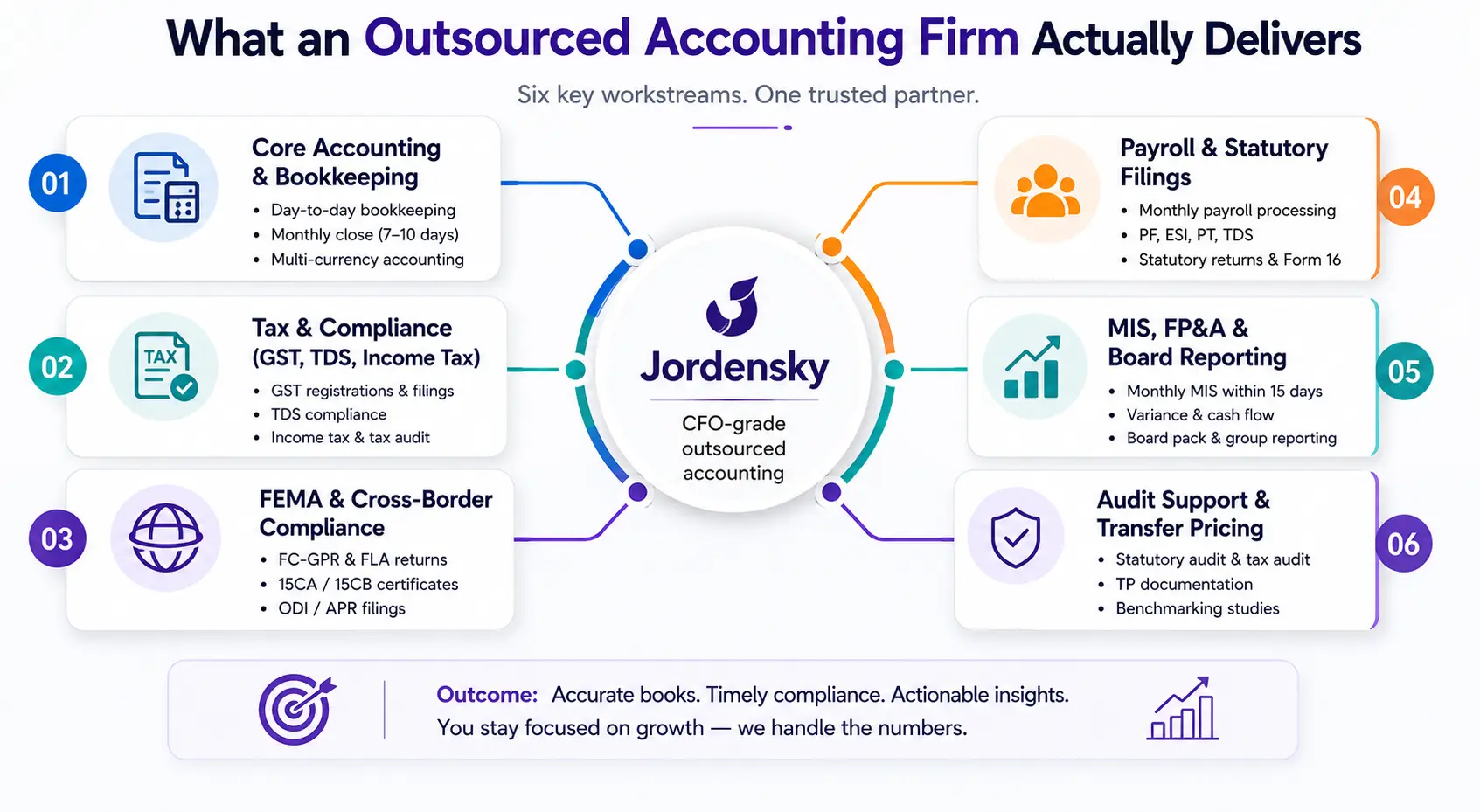
Core Accounting & Bookkeeping
- Chart of accounts setup aligned to parent-group structure
- Day-to-day bookkeeping in Indian GAAP / Ind AS
- Monthly close within 7–10 working days
- Inter-company transaction recording
- Multi-currency accounting (AUD, USD, GBP, EUR books for parent reporting)
Tax & Compliance (GST, TDS, Income Tax)
- GST registration (per state of operation), monthly GSTR-1 / GSTR-3B filings, annual GSTR-9 / 9C
- ITC reconciliation with GSTR-2B
- TDS deduction, monthly deposit (by 7th), quarterly returns (24Q, 26Q, 27Q)
- Advance tax instalments aligned to rolling profit forecast (Sections 208–211)
- Annual income tax return (ITR-6), Tax Audit (Form 3CD)
- Equalisation Levy where applicable
FEMA & Cross-Border Compliance
- FC-GPR filing within 30 days of share allotment to non-resident parent
- Annual FLA Return by 15 July
- 15CA / 15CB certificates for every overseas remittance (dividends, royalties, FTS)
- Compounding applications for past non-compliance
- ODI / APR filings for outbound investments
Payroll & Statutory Filings
- Monthly payroll processing (with TDS, professional tax, PF, ESI)
- Statutory deposits and quarterly/annual returns
- Form 16 / Form 12BA at year-end
- Gratuity, leave encashment, ESOP perquisite calculations
MIS, FP&A & Board Reporting
- Monthly MIS pack within 15 days of close
- Variance analysis (actual vs budget vs forecast)
- 13-week rolling cash flow
- Board pack for India entity board meetings (mandatory ≥4/year, gap ≤120 days)
- Parent-company group reporting (US GAAP / IFRS / UK GAAP mapping)
Audit Support & Transfer Pricing
- Statutory audit liaison (annual)
- Tax Audit (Form 3CD) and Transfer Pricing Audit (Form 3CEB) preparation
- Benchmarking studies for arm's-length pricing
- TP documentation (Master File, Local File where applicable)
- Compliance with proposed Pillar Two / BEPS rules where the parent's jurisdiction applies
10 Advantages of Outsourcing Accounting for Foreign-Owned Indian Subsidiaries
The full advantage stack, ranked by typical impact:
- One partner, one accountability line. A single CFO-grade firm owns all of accounting, GST, TDS, FEMA, payroll, and audit – instead of three separate vendors with finger-pointing potential.
- 50–70% cost saving versus an equivalent in-house team. Especially material for ₹0–100 Cr revenue subsidiaries.
- Faster monthly close. A good outsourced partner closes in 7–10 working days versus 15–25 days typical of small in-house teams.
- Multi-state GST coverage out of the box. No need to add headcount per new state.
- Built-in senior CFO access. Strategic finance, treasury, and FP&A judgement included.
- Continuous audit-readiness. Statutory audit, tax audit, transfer pricing audit, and FEMA inspection — all books and records pre-organised.
- Modern technology stack. Zoho Books / Tally / NetSuite + payroll software + GST reconciliation tools — included.
- Time-zone delivery for US/UK parents. Indian close completed overnight, ready for parent CFO review in the morning.
- No HR overhead, no attrition risk. The vendor handles its own employment, recruitment, and training.
- Risk transfer. Professional indemnity insurance, vendor liability clauses, and engagement-level SLAs shift compliance risk away from the foreign parent.
For the cash-flow operating discipline that should sit on top of the accounting function, our 7 Common Cash Flow Mistakes Indian Startups Must Avoid is the right companion read.
Cost Benchmarks — In-House vs Outsourced (2026)
A real-world look at the total cost of ownership:
| Indian Subsidiary Revenue | In-House Team Cost (Annual ₹) | Outsourced Partner Cost (Annual ₹) | Typical Saving |
|---|---|---|---|
| ₹0 – ₹5 Cr | ₹30L – ₹60L (1 Acc + part-time CA) | ₹12L – ₹25L | 50–60% |
| ₹5 – ₹25 Cr | ₹50L – ₹1.2 Cr (Accountant + Finance Manager + CA retainer) | ₹15L – ₹40L | 55–70% |
| ₹25 – ₹100 Cr | ₹1 Cr – ₹2.5 Cr (3–6 person team + senior FM) | ₹30L – ₹90L | 55–65% |
| ₹100 – ₹500 Cr | ₹2.5 Cr – ₹5 Cr (full finance team + CFO) | ₹80L – ₹2 Cr (hybrid with senior in-house) | 30–50% |
| ₹500 Cr+ | Hire full team (₹5 Cr+) | Selective outsourcing only | Mostly in-house |
Hidden costs not captured in the headline numbers:
- Recruitment costs (10–25% of CTC for senior finance hires)
- Attrition replacement (India finance attrition ~18–25% annually)
- Training and upskilling on Indian compliance
- Software and infrastructure (₹5L – ₹25L per year for modern stack)
- Management overhead for parent (1–2 hours/week of group CFO time)
A like-for-like analysis usually shows outsourcing at 35–50% of true in-house cost for foreign subs in the ₹5–100 Cr revenue band.
Risk Areas Where Outsourcing Helps Most
The five highest-risk areas for foreign-owned Indian subsidiaries — and how an outsourced partner reduces exposure:
| Risk Area | What Goes Wrong | How Outsourcing Helps |
|---|---|---|
| FEMA / FC-GPR non-compliance | 30-day FC-GPR missed → compounding penalty | Partner tracks every share allotment with calendar trigger |
| Transfer pricing audit | TP documentation back-dated, contracts incomplete | Partner maintains contemporaneous docs and Form 3CEB readiness |
| Multi-state GST classification | Wrong place of supply, ITC mismatch with GSTR-2B | Partner runs GSTR-2B reconciliation monthly |
| Advance tax mismatch | Wrong instalments → interest under 234B/234C | Partner runs rolling 12-month forecast and recalibrates quarterly |
| Statutory audit surprises | Audit adjustments in Q4 destroy MD&A narrative | Partner runs continuous audit-readiness with quarterly reviews |
These aren't theoretical risks. Foreign companies regularly take 10–30 lakh hits on penalties, interest, and rework when one of these slips. (For a deeper view on income-tax-specific issues, see our Complete Income Tax Consultant Guide for Indian Startups.)
How to Evaluate an Outsourced Accounting Partner in India
Before you sign:
- Are they a CA firm or a CFO-led firm? A pure CA firm files returns. A CFO-led firm runs finance functions. You need the latter.
- Do they have foreign-owned subsidiary experience? Generic Indian accounting firms often miss FEMA and TP nuances.
- Is there a named senior CFO on the engagement? Not an analyst with a CFO title.
- What's the SLA on monthly close? 7–10 working days is the modern bar.
- Can they handle multi-state GST and multi-currency books? Critical for any pan-India operation.
- Do they run continuous audit-readiness? Or is it a Q4 panic every year?
- What technology stack do they use? Modern (Zoho, NetSuite, and Xero) beats legacy-only (Tally-only).
- Are they PI-insured and SOC-2 / ISO certified? Risk transfer needs paper, not promises.
If a vendor can't pass 6 of 8, they aren't a CFO-grade partner — they're a compliance shop.
Common Mistakes Foreign Companies Make
- Hiring three vendors for accounting + tax + payroll. Finger-pointing on Day 1 of an audit. Pick one partner who owns all three.
- Optimising for lowest fee. A ₹10K/month "outsourced accountant" delivers bookkeeping with a fancy title. Not GST audit, not FEMA, not TP.
- No SLA in the engagement letter. Close date, MIS date, escalation matrix — all must be in writing.
- No senior in-country lead. Even with a strong vendor, a parent needs at least a half-time finance lead in India for governance.
- Treating FEMA as the vendor's problem alone. FEMA compliance is the foreign parent's risk. Joint ownership is required.
- No quarterly business review. Vendors drift in the absence of structured reviews.
- Not modelling AUD/USD/GBP-INR FX. A reporting currency vs operating currency mismatch eats reported margins.
- Outsourcing strategy along with execution. Strategic finance and FP&A should be inside the management circle, not at arm's length.
Expert Tips for a High-ROI Outsourcing Relationship
- Define the scope in writing. Use a RACI matrix covering every workstream – accounting, GST, TDS, FEMA, payroll, audit, and FP&A.
- Have a named senior CFO from the vendor. This is the difference between a transactional vendor and a strategic partner.
- Install a Monday cadence. 30-minute weekly call, monthly MIS review, quarterly business review.
- Anchor the relationship to KPIs. Close by Day 10, ±5% forecast accuracy, zero compliance notices, and monthly GST reconciliation done by Day 15.
- Run a 90-day pilot. Before committing to a 12-month engagement, validate the vendor on a real workload.
- Insist on direct access to the team. Senior CFO + lead manager + reviewer = three people you should know by name.
- Plan a 12-month roadmap, not just monthly close. ESOP, fundraising, auditing, valuation, transfer pricing — sequence them so the vendor can deliver in advance.
- Re-bid every 3 years. Even with a great partner, market-test pricing and scope every 36 months.
When You Should NOT Outsource
To be balanced—outsourcing isn't always right:
- Revenue above ₹100 Cr with high complexity. At this scale, an in-house finance organisation under a full-time CFO becomes more efficient and more strategically valuable.
- Regulated entities (NBFC, insurance, and bank). Sector regulators expect deep in-house ownership for many functions.
- Pre-IPO or IPO-stage. SEBI listing requirements expect in-house finance leadership and may treat outsourced controllership unfavourably.
- Strategic moves (M&A, restructuring, and fundraising). Outsource execution; keep strategic finance in-house under a CFO.
- When governance has historically been weak. Outsourcing on top of a broken process magnifies problems before solving them.
For most foreign companies in India in 2026 – these exceptions aside – outsourcing is the right default.
Looking for an outsourced accounting partner for your Indian subsidiary? Jordensky's CFO-led practice has handled accounting, GST, FEMA, transfer pricing, and audit for 100+ foreign-owned Indian subsidiaries – across SaaS, BFSI, manufacturing, GCCs, and life sciences. One partner, one SLA, one CFO-level outcome.
Talk to a CFO Today → 30-minute consultation. No commitment. CFO-level insights, not a sales pitch
Frequently Asked Questions
1. Why should a foreign company outsource accounting in India?
Foreign-owned Indian subsidiaries face a multi-domain compliance stack (GST, TDS, FEMA, transfer pricing, audit) with 40+ submissions a year. An outsourced CFO-grade partner consolidates all of this under one accountable engagement, typically at 35–50% of the cost of an equivalent in-house team, with faster monthly closes and continuous audit-readiness.
2. How much does outsourced accounting in India cost in 2026?
For an Indian subsidiary with ₹0–5 Cr revenue, ₹12L–₹25L per year. For ₹5–25 Cr revenue, ₹15L–₹40L. For ₹25–100 Cr revenue, ₹30L–₹90L. Above ₹100 Cr, hybrid models (senior in-house + outsourced execution) typically work better.
3. What does an outsourced accounting firm in India typically cover?
Bookkeeping, monthly close, multi-state GST, TDS, advance tax, FEMA filings (FC-GPR, FLA, 15CA/15CB), payroll, statutory and tax audit liaison, Form 3CEB transfer pricing, board reporting, MIS, and parent-group GAAP mapping (US GAAP / IFRS).
4. Is outsourced accounting safe for a foreign-owned subsidiary?
Yes — with the right partner. Look for a CFO-led firm with PI insurance, SOC-2 or ISO certification, multi-domain expertise, a named senior CFO on the engagement, and a written SLA. Outsourcing actually reduces compliance risk for most foreign subsidiaries by consolidating ownership and improving close discipline.
5. Can outsourced accounting firms handle FEMA and transfer pricing?
A CFO-grade firm yes; a generic accounting firm no. Confirm specifically whether the firm has filed FC-GPR, Form 3CEB, and 15CA/15CB recently for foreign-owned subsidiaries — it's a real differentiator.
6. How long does it take to onboard an outsourced accounting partner?
A modern CFO-grade firm onboards in 1–3 weeks: chart of accounts review, prior-year cleanup, integration with parent reporting, SLA agreement, and first monthly close cycle.
7. Do I still need an in-house finance person if I outsource?
For most ₹5 Cr+ revenue subsidiaries, yes — at least a halftime or full-time India finance lead who interfaces with the outsourced partner, the management team, and the parent. The leader doesn't do the work; they govern it.
8. What's the difference between an accountant, a CA, and an outsourced accounting firm?
An accountant maintains books. A Chartered Accountant (CA) handles statutory and tax audits and selected compliance work. An outsourced accounting firm bundles all of these under a single engagement with senior CFO oversight, technology, and SLAs.
9. How do I evaluate an outsourced accounting partner?
Use the 8-point test: CFO-led structure, foreign subsidiary experience, named senior CFO, monthly close SLA, multi-state and multi-currency capability, continuous audit-readiness, modern tech stack, and PI insurance / certifications.
10. Can the outsourced partner also provide CFO services?
Yes — and bundling matters. A CFO-grade outsourced partner typically offers a continuum: bookkeeping → tax & compliance → MIS & FP&A → Virtual CFO. Many foreign subsidiaries start with accounting and expand to virtual CFO as their India operation scales.
Final Takeaway — Outsource the Function, Own the Discipline
For foreign-owned Indian subsidiaries in 2026, outsourcing accounting is the default move — not the contrarian one. The economics, the compliance complexity, the technology stack, and the rising risk of FEMA / TP / GST surprises all point to a single CFO-grade partner handling the function end-to-end.
But outsourcing the function does not mean outsourcing the discipline. The parent must still install a monthly cadence, define KPIs, govern the engagement, and treat the partner as a strategic extension of the finance team — not a back-office vendor.
Get those two right — the right partner and the right governance — and your India operation becomes one of the most predictable, audit-ready, and capital-efficient parts of the group.