The companies that survive 2026 are not the ones cutting headcount in panic. They're the ones that fix cash flow at the source – with a CFO-level operating playbook that treats cost as a system, not a budget line. Most Indian founders look at a tight quarter and start slashing marketing, salaries, and travel. Three months later, the cash position hasn't changed because the real leaks were never closed: a bloated SaaS stack, a 95-day DSO, an unclaimed GST refund, and three customers below gross margin breakeven.
This guide is the playbook we run with founders every week. Eight practical, ranked moves that compound — most of them executable in 30 to 90 days with measurable cash impact. You'll get the benchmarks, the trade-offs, the order of operations, and the mistakes that quietly kill cost programmes before they show results.
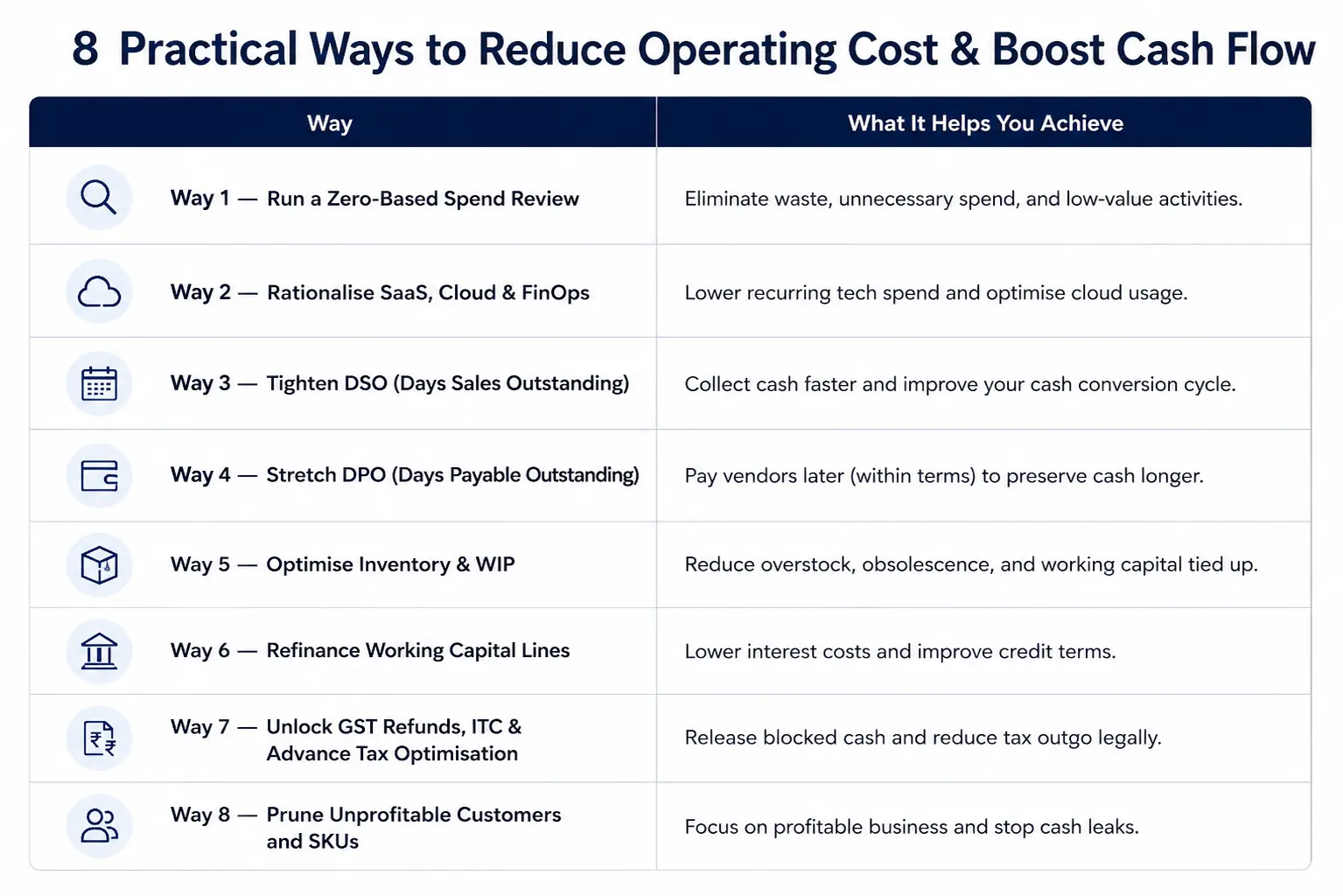
The 8 Highest-Leverage Moves
The eight CFO-tested moves, ranked by typical impact and speed for Indian SMEs and startups in 2026:
| # | Move | Typical Cash Impact | Time to Show Results |
|---|---|---|---|
| 1 | Zero-Based Spend Review | 8–15% of OpEx | 30–60 days |
| 2 | SaaS / Cloud / FinOps Rationalisation | 15–35% of cloud + SaaS spend | 30–45 days |
| 3 | Tighten DSO (Receivables) | 10–25% reduction in DSO days | 60–120 days |
| 4 | Stretch DPO (Payables) — Smartly | 10–20 days added DPO | 30–90 days |
| 5 | Inventory & WIP Optimisation | 15–30% inventory reduction | 60–180 days |
| 6 | Refinance Working Capital Lines | 100–300 bps interest cost saving | 45–90 days |
| 7 | GST Refunds, ITC & Advance Tax Optimisation | 1–3% of revenue (cash unlock) | 30–90 days |
| 8 | Prune Unprofitable Customers & SKUs | 5–15% gross margin lift | 60–120 days |
A disciplined founder running 6 of these 8 moves in parallel typically frees up 2–5 months of additional runway within a single quarter — without firing a single person.
(For the full operating playbook on cash discipline, see our Cash Flow Management: A Practical Guide for Indian Businesses.)
Why Cost & Cash Flow Are the Same Conversation
Most founders treat cost reduction and cash flow improvement as separate projects. They're not. In 2026, three forces have collapsed them into one operational discipline:
- Capital is expensive. Indian SME working capital lines now price 200–400 bps above where they did three years ago. Every rupee of unnecessary OpEx costs you twice — once in the P&L and again in the credit line you have to draw.
- AI and FinOps tooling have matured. A 4-person finance team in 2026 can cut 30–35% of cloud, SaaS, and vendor costs in 60 days using tools that didn't exist in 2022.
- GST and tax timing have become cash flow tools, not just compliance items. Output GST is paid before receivables are collected. Advance tax is paid quarterly on forecasted profit. These mechanics decide cash position more than any single cost line.
The CFOs winning in 2026 are running cost and cash flow on the same dashboard every Monday morning.
Way 1 — Run a Zero-Based Spend Review
The single highest-leverage move in the first 30 days. Take every cost category and force the team to rejustify it from scratch — not "What did we spend last year?" But what would we spend if we were starting today?
How to run it:
- List every line in OpEx greater than ₹50,000/month
- For each, ask, 'IsIs this still necessary?' At what level? Is there a cheaper alternative?
- Categorise into Keep / Reduce / Cut / Replace
- Set a target reduction of 10–15% of total OpEx in 60 days
A typical Indian startup running this exercise finds:
- 8–12% of SaaS subscriptions never used
- 3–5 vendors charging above market for commodity services
- 2–4 categories where consolidation saves 20%+
- Travel, hospitality, and admin spend bloated by 15–25%
Zero-based reviews are not a one-time project. The best CFOs run them every 12 months as a discipline.
Way 2 — Rationalise SaaS, Cloud & FinOps
In 2026, the average Indian growth-stage startup pays for 45–80 SaaS tools and 3–5 cloud services. A good FinOps audit cuts 15–35% in 60 days.
The framework:
| Category | What to Audit | Typical Saving |
|---|---|---|
| SaaS subscriptions | Logins, last-active dates, overlapping tools | 15–25% |
| Cloud (AWS / Azure / GCP) | Right-sizing, reserved instances, savings plans | 20–35% |
| Annual contracts | Renewal terms, auto-renewal clauses, multi-year commits | 10–20% |
| AI / LLM API spend | Prompt caching, model right-sizing, batched inference | 25–60% |
| Data warehouse / BI | Query optimisation, storage tiers, idle compute | 20–40% |
Three quick wins: negotiate annual cloud commits before renewal, not at renewal; kill SaaS tools with under 50% active seats; and switch chargeable AI inference workloads to cached / batched mode wherever response time isn't critical.
A focused FinOps sprint typically pays for itself 5–10x in the first quarter.
Way 3 — Tighten DSO (Days Sales Outstanding)
Every day of DSO above the industry benchmark is cash sitting in someone else's bank account. Indian benchmarks for context:
| Industry | Healthy DSO | Red Flag DSO |
|---|---|---|
| SaaS (B2B annual contracts) | 30–45 days | > 60 days |
| D2C / E-commerce | 0–15 days | > 30 days |
| Services / Consulting | 30–60 days | > 75 days |
| Manufacturing | 45–75 days | > 90 days |
| Enterprise Sales (large GCC clients) | 60–90 days | > 120 days |
Five practical levers:
- Move billing to milestones, not month-end. Bill on contract signing, kickoff, mid-project, and delivery.
- Take a 30–50% advance for projects above ₹10L. This alone shifts the cash conversion cycle by weeks.
- Automate dunning: Day 0 invoice, Day 25 reminder, Day 45 escalation, Day 60 finance call. No human discretion.
- Offer 1–2% early-payment discounts on invoices above a threshold.
- Tier customer credit terms. A new customer should not get the same terms as a 5-year repeat client.
Tightening DSO by 15 days on a ₹50 Cr revenue book frees roughly ₹2 Cr of cash – without — without touching cost.
Way 4 — Stretch DPO (Days Payable Outstanding)
DPO is the inverse lever. The goal is not to delay vendor payments and damage relationships — it's to negotiate structurally longer terms in exchange for predictability or volume.
Tactical playbook:
- Negotiate Net-45 or Net-60 with non-strategic vendors, anchored on annual volume commitments
- Move recurring payments to monthly auto-debit in exchange for 30-day extension
- Use vendor financing or supply chain finance programs (offered by RBL, ICICI, HDFC, Yes Bank) — they let you stretch DPO without straining the vendor
- For strategic vendors: don't stretch payment; negotiate price instead. Cheaper to pay on time at a 5% discount than to pay late at full price.
Be deliberate. Founders who unilaterally extend DPO without a conversation lose vendor goodwill, and the cost shows up later in worse pricing or stockouts.
Way 5 — Optimise Inventory & WIP
For product, D2C, and manufacturing companies, inventory is the single largest cash sink.
Three frameworks that work:
- ABC analysis. Top 20% of SKUs by revenue (A items) get tight forecasting and just-in-time replenishment. The bottom 50% (C items) get culled.
- Slow-mover liquidation. Anything older than 90 days at <50% sell-through gets discounted out. Holding cost > revenue lost.
- Vendor-managed inventory (VMI). Push inventory back up the supply chain to your vendors where possible.
A typical SME running this exercise frees up 15–30% of inventory cash within 6 months — with no impact on top-line sales if it's done with discipline.
Way 6 — Refinance Working Capital Lines
Most Indian SMEs are paying 100–300 bps more than they need to on working capital, because they renew with the same bank year after year without bidding it out.
A 90-day refinancing process:
- Pull current cost stack — interest rate, processing fees, collateral, covenants
- Build a clean financial pack — last 3 years' audited financials, 18-month forecast, and a customer concentration analysis
- Approach 4–5 lenders in parallel — including PSU, private, NBFC, and at least one new-age digital lender
- Compare on landed cost, not headline interest rate (fees, prepayment penalties, drawdown flexibility all matter)
- Refinance to a blended structure — overdraft + invoice discounting + supplier finance often beats a single CC line
For a profitable ₹50 Cr company carrying ₹15 Cr of working capital, a 200 bps reduction = ₹30L of P&L impact annually.
Way 7 — Unlock GST Refunds, ITC & Advance Tax Optimisation
Tax is the most under-exploited cash flow lever in Indian SMEs.
Three levers most founders are leaving on the table:
| Lever | What It Does | Typical Cash Unlock |
|---|---|---|
| GST Refunds (Exports / Inverted Duty) | Recovers accumulated input tax credit | 1–3% of revenue |
| Input Tax Credit (ITC) Reconciliation | Closes mismatches between GSTR-2B and books | 0.5–2% of revenue |
| Advance Tax Smoothing | Aligns quarterly instalments with actual profit (avoids 234B/234C interest) | Cash timing benefit, 0.3–0.8% |
Most SMEs run GST and income tax as compliance, not as cash levers. The shift in mindset — tax planning is cash flow planning — is one of the fastest gains a CFO unlocks.
For a deeper view on what a senior CFO actually delivers across these areas, see our Startup CFO Services Cost in India: The Definitive 2026 Guide.
Way 8 — Prune Unprofitable Customers and SKUs
The most uncomfortable move on this list — and often the highest-impact one.
Run this exercise quarterly:
- Calculate gross margin per customer and per SKU / product line
- Identify the bottom 20% by margin contribution
- For each, ask: Is this strategic (logo, channel, learning) or just inertia?
- Prune the inertia category — don't renew, raise prices, or transition to a leaner service model
A typical mid-sized B2B services or D2C company finds the following:
- 5–10% of customers below gross margin breakeven (you're paying to serve them)
- 15–25% of SKUs contributing under 5% of total margin
- 1–2 channel partners costing more than they bring
Pruning these usually lifts blended gross margin by 5–15 percentage points and frees significant working capital. Founders often resist this — but every great CFO has run this exercise at every company they've worked at, every year.
Businesses can save significant time, money, and materials by focusing on operational efficiency and process standardization. Cross-training employees, reducing unnecessary steps, optimizing workflows, organizing inventory access, and standardizing best practices all help improve productivity. Companies can also reduce downtime by improving material usage, identifying bottlenecks, staggering shifts, and finding better ways to manage waste. Beyond operations, many businesses overlook inefficiencies in management processes, where automation and standardized digital workflows can replace repetitive manual tasks and create substantial long-term value.
Quick Wins vs Structural Moves — A 90-Day Plan
A practical sequencing for an Indian SME or startup:
| Days | Quick Wins (Execute Immediately) | Structural Moves (Begin Now, Compound Later) |
|---|---|---|
| 0–30 | SaaS / cloud audit; cancel unused; pause discretionary travel | Start refinancing conversations with 4–5 lenders |
| 30–60 | Implement automated dunning; negotiate top 10 vendor renewals | Begin zero-based spend review; rebuild chart of accounts |
| 60–90 | Tighten payment terms on new contracts; liquidate slow-moving inventory | Customer/SKU profitability cut; GST refund filing |
| 90+ | Roll into the operating rhythm | Quarterly review cadence; tie to forecast |
The mistake founders make: trying to do all 8 at once. Pick 3 quick wins and 2 structural moves in the first 90 days. Stack the rest in Q2.
How to Measure Impact — The Cash Flow Scorecard
A clean dashboard a CFO maintains weekly:
| Metric | Definition | Target Trend |
|---|---|---|
| DSO | Avg days to collect receivables | ↓ 10–25% |
| DPO | Avg days to pay vendors | ↑ 10–20 days |
| Cash Conversion Cycle (CCC) | DSO + DIO − DPO | ↓ 15–30 days |
| Operating Cash Flow | Cash from operations / period | ↑ Quarter-on-quarter |
| Burn Multiple (for startups) | Net burn / Net new ARR | ↓ Toward 1.0 |
| OpEx % of Revenue | OpEx / Revenue | ↓ 200–400 bps |
| Cash Runway | Cash / monthly net burn | ↑ 2–5 months |
| GST ITC Mismatch | Books ITC – GSTR-2B ITC | → ₹0 monthly |
Without a scorecard, every cost initiative drifts. With one, the founder sees compounding impact every Monday morning.
Common Mistakes That Kill Cost-Cutting Initiatives
- Cutting headcount first. It's the loudest cost line but rarely the highest-leverage one. Start with structural waste (SaaS, vendors, working capital, and tax) before touching people.
- One-time cuts, no operating rhythm. Without quarterly reviews, costs grow back.
- Cutting marketing in a downturn. Cuts revenue 6–12 months later. Cut unprofitable marketing channels, not the function.
- Ignoring tax timing. Advance tax mismatches and GST ITC leakage can quietly destroy a quarter's cash position.
- Treating DSO/DPO as accounting. They're CEO-level metrics — track them in the weekly leadership review.
- No one owns the programme. A cost programme without a single accountable leader (CFO or COO) drifts in 60 days.
- Confusing OpEx % with absolute OpEx. A growing company should see OpEx % fall while absolute OpEx grows. Cutting absolute OpEx during growth is usually a mistake.
- Skipping the working capital refinance. It's the single biggest cash lever most founders never pull.
If you're heading into a fundraiser on top of a cost reset, our 9 Step Checklist for Raising Funds for Startups in India covers the parallel prep.
How to Maintain Sustainable Cash Flow
- Run a 13-week rolling cash forecast. Updated weekly. The single most important CFO discipline.
- One owner per cost category. SaaS owned by IT. Vendors by Procurement. Marketing by CMO. No orphan costs.
- Anchor every decision to cash, not P&L. Profit is an opinion; cash is a fact.
- Tie cost discipline to incentives. OpEx targets in leadership variable pay shift behaviour faster than memos do.
- Negotiate annually, not at renewal. The best vendor terms come from competitive bids, not loyalty discounts.
- Build a "kill list" every quarter. Two SaaS tools, one vendor, one channel. Force the discipline.
- Don't outsource the program — own it. A CFO designs and runs it; the team executes; the founder enforces.
Want to free up 2–5 months of runway in 90 days? Jordensky's Virtual CFO team in Mumbai runs cost and cash flow programmes for 100+ Indian startups and SMEs — across SaaS, D2C, services, and manufacturing. We audit your OpEx, refinance your working capital, recover unclaimed GST, and tighten your cash conversion cycle. Outcomes are measurable, weekly, and accountable.
Talk to a Virtual CFO → 30-minute consultation. No commitment. CFO-level insights, not a sales pitch.
Frequently Asked Questions
1. What is the fastest way to improve cash flow in a small business?
Tighten DSO. Send invoices on the day the work is delivered (not month-end), automate dunning at Day 25 and Day 45, and take 30–50% advances on contracts above ₹10L. A 15-day DSO reduction frees ~3–4% of revenue in cash within 60 days.
2. How do I reduce operating costs without cutting headcount?
Start with structural waste: SaaS rationalisation (15–35% saving), cloud/FinOps optimisation (20–35%), working capital refinancing (100–300 bps), GST and ITC recovery (1–3% of revenue), and vendor renegotiation. Most companies free 8–15% of OpEx without touching people's jobs.
3. What is a healthy DSO for an Indian SME?
Healthy DSO depends on the industry. SaaS B2B: 30–45 days. D2C: 0–15 days. Services: 30–60 days. Manufacturing: 45–75 days. Enterprise sales (especially to large GCCs): 60–90 days. DSO above the red-flag threshold for your industry is usually an operational problem, not a customer problem.
4. How can I improve cash flow without affecting growth?
Focus on cash levers that are growth-neutral: vendor terms, working capital refinancing, GST refunds, SaaS rationalisation, customer/SKU pruning of unprofitable accounts. Avoid cutting marketing or product investment unless ROI is clearly negative.
5. What is the difference between cost reduction and cash flow improvement?
Cost reduction lowers OpEx in the P&L. Cash flow improvement frees up cash through timing — DSO, DPO, inventory, working capital, and tax timing. The best programmes run both in parallel because they reinforce each other.
6. How often should I run a zero-based spend review?
Annually. Most Indian SMEs let costs creep 5–10% per year through automatic renewals, scope expansion, and unchallenged subscriptions. A yearly zero-based review resets the baseline and surfaces 8–15% in savings.
7. Can a CFO help us cut operating costs?
Yes. A senior CFO (full-time, fractional, or outsourced) typically delivers 8–15% of OpEx savings and 15–30 days of cash conversion cycle improvement within 90 days. The cost of the engagement is usually paid back 3–10x in the first year.
8. What is FinOps and why does it matter for startups?
FinOps is the discipline of managing cloud and SaaS spend with the same rigour as financial planning. For Indian startups in 2026, FinOps typically saves 20–35% on cloud and 15–25% on SaaS — usually within 60 days of starting.
9. How does GST refund help cash flow?
For exporters and businesses with inverted duty structures, accumulated input tax credit can be refunded. Most SMEs leave 1–3% of revenue locked in unclaimed GST refunds. Filing on time releases this as direct cash.
10. What is the cash conversion cycle (CCC), and how do I improve it?
CCC= DSO + DIO − DPO. It measures how many days cash is locked in operations. Improve it by reducing DSO (collect faster), reducing DIO (less inventory), and stretching DPO (pay vendors smartly). A 15–30 day CCC reduction typically frees 10–20% of working capital.
Final Takeaway — Cash Flow Is a Discipline, Not a Project
The companies that win 2026 don't run cost-cutting drives. They run a monthly cash flow operating rhythm — DSO reviewed every Monday, DPO every quarter, SaaS audited semi-annually, GST refunds filed monthly, and customer profitability re-cut every quarter. None of it is dramatic. All of it compounds.
Pick the three highest-leverage moves on your list this week. Set a 90-day target for each. Build the scorecard. Review it weekly. By Q2 you'll have 2–5 months of additional runway you didn't have to fundraise for.
That's the real CFO playbook — not a one-time cost cut, but a system that gets cheaper to run every quarter.