Bad CFOs cut costs. Great CFOs design the system that keeps costs in line – quarter after quarter, without panic, without headcount drama, without sacrificing growth. The difference is invisible in good times and decisive in tight ones.
In 2026, with capital expensive and revenue cycles longer, every Indian founder is asking their CFO the same question: Where can we be leaner without slowing down? The CFOs who answer with a one-time spreadsheet of cuts are doing the job badly. The CFOs who answer with a 5-layer cost management system — strategic alignment, structural architecture, operating optimisation, MIS and dashboards, and governance rhythm — are running businesses that compound.
This is the CFO-level playbook we install with founders and finance teams. You'll get the framework, the 7 highest-leverage strategies, the MIS structure, the KPI scorecard, the 90-day plan, and the mistakes that quietly destroy cost programmes before they show results.
What CFO Cost Management Actually Means
CFO cost management is the discipline of architecting, monitoring, and continuously optimising the company's cost structure — not as a one-time exercise, but as a system embedded in the financial operating rhythm.
A mature CFO cost management practice has five layers:
- Strategic alignment — costs aligned to the next 18 months of revenue and competitive moves
- Structural architecture — fixed/variable/discretionary mix designed for the business model
- Operating optimisation — vendor terms, procurement, working capital, FinOps
- MIS & dashboards — real-time visibility of every cost category with variance triggers
- Governance rhythm — weekly, monthly, quarterly cadences with named owners
A CFO running all five layers typically delivers an 8–15% OpEx reduction in Year 1, with another 200–400 bps per year compounding thereafter — without crisis-mode cuts.
Why CFO Cost Management Is a System, Not a Project
Three forces will have collapsed cost management and financial reporting into one discipline in 2026:
- Capital is expensive. Working capital lines are priced 200–400 bps above where they were in 2022. Every avoidable rupee of OpEx now costs you twice — once in P&L, once in the credit line you draw on.
- AI and FinOps tooling have matured. A 4-person finance team in 2026 can monitor cloud, SaaS, vendor, payroll, and capex spend in real-time — with variance alerts. Cost visibility went from monthly to weekly to live.
- Investors and boards now expect cost-as-a-system discipline. "We cut ₹2 Cr last quarter" is no longer impressive. "Our OpEx/revenue ratio fell 220 bps year-on-year because of the structural changes we made in Q1".
The cleanest way to think about it: a CFO doesn't cut costs. A CFO designs the system that keeps costs in line.
For the underlying MIS and reporting discipline that makes this possible, see our MIS Report Services for Indian Startups: Real-Time Financials for Smart Decision-Making.
The CFO Cost Management Framework — 5 Strategic Layers
Each layer feeds the next. Skipping one weakens the whole.
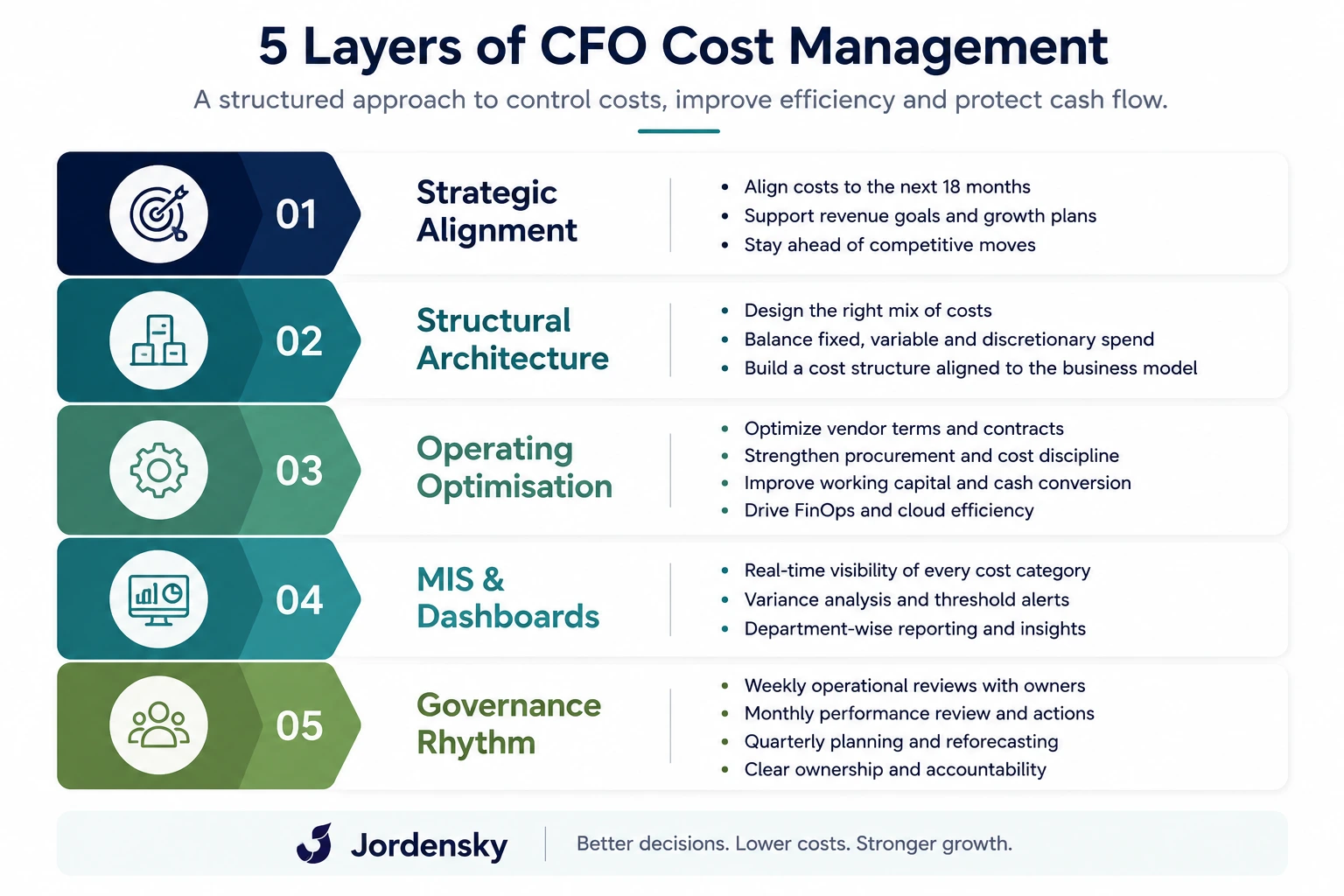
Layer 1 — Strategic Alignment
Cost decisions must trace back to strategy. Before any cost discussion, the CFO asks: What are we trying to win in the next 18 months? If growth is the goal, you protect sales and product investment and cut elsewhere. If profitability is the goal, the whole equation shifts.
The CFO output here: a documented OpEx target by department, tied to revenue targets and competitive context.
Layer 2 — Structural Cost Architecture
Every cost is one of three types: fixed, variable, or discretionary. The CFO architects the mix:
- Fixed: rent, salaries, software, depreciation
- Variable: COGS, commissions, payment fees, AI inference, cloud usage
- Discretionary: marketing, hiring, travel, events
The right ratio depends on stage and business model. A SaaS Series A is usually too fixed-heavy. A D2C scaling brand is usually too variable-heavy. A CFO re-architects this before optimising day-to-day.
Layer 3 — Operating Cost Optimisation
The tactical playbook includes vendor negotiations, procurement, FinOps (cloud + SaaS rationalisation), working capital terms, tax timing, GST refunds, and advance tax smoothing. This is where 8–15% of OpEx savings live.
Layer 4 — MIS, Dashboards & Variance Analysis
The visibility layer. Every cost category tracked monthly (or weekly, for high-velocity items), benchmarked to budget, with variance triggers. A CFO who can't see the variance can't manage the cost.
Layer 5 — Governance & Operating Rhythm
The CEO-CFO-functional-leader cadence. Weekly reviews of cash, DSO, DPO. Monthly variance reviews by department. Quarterly cost reviews at the board level. Annual zero-based reset.
A cost programme without governance dies in 60 days. A cost programme with governance compounds for years.
The 7 Highest-Leverage Strategies a CFO Uses
Ranked by typical impact and durability:
| # | Strategy | Typical Cash Impact | Time to Show Results |
|---|---|---|---|
| 1 | Zero-Based Spend Review (annual reset) | 8–15% of OpEx | 30–60 days |
| 2 | FinOps — SaaS, Cloud, AI Inference Rationalisation | 15–35% of cloud + SaaS spend | 30–45 days |
| 3 | Working Capital Cycle Tightening (DSO, DPO, DIO) | 15–30 day CCC reduction | 60–120 days |
| 4 | Vendor & Procurement Re-bidding | 5–20% on top 30 vendors | 60–90 days |
| 5 | Customer & SKU Profitability Pruning | 5–15% gross margin lift | 60–120 days |
| 6 | Tax & GST Optimisation (ITC, refunds, advance tax) | 1–3% of revenue | 30–90 days |
| 7 | Headcount Rationalisation (last resort, not first) | 10–25% of payroll | 30–60 days |
The order matters. A CFO who reaches for headcount cuts first is doing the job in reverse. Headcount is the loudest cost line but rarely the highest-leverage one — and almost always the most damaging if cut first.
For specific operational tactics across categories, our Outsourced CFO Services in India for Foreign Companies: Key Insights walks through how a CFO bundles many of these strategies inside a single engagement.
MIS & Dashboard Structure for Cost Management
A CFO-grade cost management MIS has, at minimum, these views – refreshed monthly (most) or weekly (top-of-stack):
| MIS View | What It Shows | Refresh Cadence |
|---|---|---|
| OpEx by Category | Each cost line vs budget vs prior year, with variance % and explanation | Monthly |
| OpEx % of Revenue | Total OpEx and category-wise as % of revenue, trended | Monthly |
| Cash Conversion Cycle | DSO, DIO, DPO — and CCC trend | Weekly |
| Top 20 Vendors | Spend, contract status, renewal date, alternatives mapped | Quarterly |
| SaaS / Cloud / AI Spend | Tool-level spend, active users, idle resources, renewal calendar | Monthly |
| Headcount Plan vs Actual | Open positions, CTC drift, attrition replacement cost | Monthly |
| Gross Margin by Segment | By product, customer cohort, channel | Monthly |
| GST / Tax Cash Position | Output GST paid, ITC available, refunds pending | Monthly |
| Variance Triggers | Any line >5% off plan, with owner and action | Live |
The cardinal rule: the CFO doesn't review the dashboard alone. It's reviewed with the CEO and the department owner. Accountability is the whole point of the MIS.
For a deeper view on what MIS-driven cost management looks like in a specific sector, our Virtual CFO for Manufacturing: What to Expect covers manufacturing-specific cost MIS – landed cost, capacity utilisation, scrap and yield – that translates well to other sectors.
The Cost KPI Scorecard Every CFO Should Track
The single page a CFO reviews weekly with the CEO. Trend matters more than absolute value.
| KPI | Definition | Target Trend |
|---|---|---|
| OpEx % of Revenue | Total OpEx / Revenue | ↓ 200–400 bps YoY |
| Gross Margin % | Gross Profit / Revenue | ↑ 50–200 bps YoY |
| EBITDA Margin | EBITDA / Revenue | ↑ Stage-appropriate |
| Cost Conversion Cycle (CCC) | DSO + DIO − DPO | ↓ 15–30 days |
| Burn Multiple (for startups) | Net Burn / Net New ARR | ↓ toward 1.0 |
| Cloud / Revenue % | Cloud spend / Revenue | ↓ 50–150 bps/year |
| SaaS Spend / Employee | SaaS spend / Active employees | Flat or ↓ |
| Vendor Concentration | Top 10 vendors / Total OpEx | ↓ toward 50–60% |
| Forecast Accuracy | Actuals vs Forecast at EBITDA | ±5% |
| Compliance Notices | GST / TDS / ROC penalties received | = 0 |
Without a scorecard, every cost initiative drifts. With one, compounding improvement is visible every Monday.
Cost Optimisation Across Common Categories
The CFO's playbook by category — what to look at and what to fix:
| Cost Category | Typical Issue | CFO Move | Typical Saving |
|---|---|---|---|
| Cloud (AWS/Azure/GCP) | Over-provisioned, no reserved instances | Right-size + savings plans + commitments | 20–35% |
| SaaS Subscriptions | 30–50% inactive seats | Quarterly seat audit + consolidation | 15–25% |
| AI / LLM Inference | Wrong model size, no caching | Model right-sizing + prompt caching + batching | 25–60% |
| Vendor / Procurement | Single-source legacy contracts | Competitive bids on top 30 vendors | 5–20% |
| Payroll & Hiring | Mis-aligned hiring plan | Hiring freeze on non-strategic roles | 10–25% |
| Real Estate | Pre-COVID footprint, low utilisation | Hybrid policy + sublease + smaller footprint | 20–50% |
| Travel & Hospitality | Open policy, no caps | Tiered approval + preferred-vendor program | 25–40% |
| Marketing | Channels without ROI | Kill bottom 20% of channels | 10–30% of marketing |
| Customer Success / Support | Same SLA for all tiers | Tiered SLA by ARR or margin | 15–30% |
| Statutory & Compliance | Multiple vendors, gaps | Consolidate under one CFO-grade partner | 30–50% |
A 2026 CFO running this matrix typically frees 8–15% of OpEx in year 1 – without — without cutting headcount.
The 90-Day CFO Cost Optimisation Plan
A practical sequencing that compounds:
| Days | Quick Wins (Execute Immediately) | Structural Moves (Begin Now, Compound Later) |
|---|---|---|
| 0–30 | SaaS / cloud audit, cancel unused; pause discretionary travel; build OpEx-by-category MIS | Start refinancing conversations with 4–5 lenders; rebuild chart of accounts |
| 30–60 | Implement automated dunning (DSO); negotiate top 10 vendor renewals; install KPI scorecard | Begin zero-based spend review; document cost ownership per category |
| 60–90 | Tighten payment terms on new contracts; liquidate slow inventory; install weekly variance reviews | Customer / SKU profitability cut; GST refund filing; vendor consolidation |
| 90+ | Roll into the operating rhythm | Quarterly review cadence; tie to forecast; annual zero-based reset |
The mistake CFOs make: trying to do everything at once. Pick 3 quick wins and 2 structural moves in the first 90 days. Stack the rest in Q2.
Common CFO Cost Management Mistakes
- Cutting headcount first. It's loud, but rarely the highest-leverage move. Start with structural waste (SaaS, vendors, working capital, and tax) before touching people.
- One-time cuts, no operating rhythm. Without quarterly reviews, costs grow back.
- Cutting marketing in a downturn. Cuts revenue 6–12 months later. Cut unprofitable channels, not the function.
- Ignoring tax timing. Advance tax and GST timing destroy more cash positions than most cost lines.
- No-cost ownership matrix. SaaS owned by IT. Vendors are by procurement. Marketing by CMO. No orphan costs.
- Treating MIS as accounting. MIS is a management tool. If finance is the only function reading the dashboard, it's not working.
- Reviewing cost monthly, not weekly, for top-of-stack items. Cloud, SaaS, AI inference, and cash position need weekly eyes.
- Confusing OpEx % with absolute OpEx. A growing company should see OpEx % fall while absolute OpEx grows. Cutting absolute OpEx during growth usually destroys value.
- No annual zero-based reset. Costs creep 5–10% per year through automatic renewals. The annual reset breaks the creep.
- Sourcing finance + tax + payroll from three vendors. Finger-pointing on Day 1 of an audit. One CFO-grade partner solves this.
Tips for Sustainable Cost Discipline
- Run a 13-week rolling cash forecast. Updated weekly. The single most important CFO discipline for cost management.
- One owner per cost category. SaaS owned by IT. Vendors by procurement. Marketing by CMO. The CFO owns the system.
- Anchor every decision to cash, not P&L. Profit is an opinion; cash is a fact.
- Tie cost discipline to incentives. OpEx targets in leadership variable pay shift behaviour faster than memos do.
- Negotiate annually, not at renewal. The best vendor terms come from competitive bids, not loyalty discounts.
- Build a "kill list" every quarter. Two SaaS tools, one vendor, one channel. Enforce the discipline.
- Don't outsource the program — own it. A CFO designs and runs it, the team executes it, and the CEO enforces it.
- Stress-test the cost base annually. Can the business survive 6 months at 70% of plan? If not, the worst case isn't bad enough.
When Cost Cutting Hurts (And How CFOs Avoid It)
A great CFO knows that cutting the wrong cost is worse than not cutting anything. The traps to avoid:
- Cutting marketing during a growth slowdown. Cuts revenue 6–12 months later. Cut unprofitable channels instead.
- Cutting customer success during a churn spike. Magnifies the churn. Tier the CS motion instead.
- Cutting product investment in a competitive market. Hands the market to competitors. Reallocate within the product instead.
- Cutting compliance vendors to save fees. Triggers penalties that exceed the savings tenfold.
- Cutting senior talent first. Loses institutional knowledge fastest and is hardest to replace.
- Cutting capex on production capacity at the wrong moment. Shows up as missed revenue when demand returns.
The rule: cost cuts should never reduce the company's ability to recover and grow. If they do, you've cut the wrong thing.
Want to install a CFO-grade cost management system? Jordensky's Virtual CFO in Bangalore has built cost MIS, dashboards, and operating rhythms for 100+ Indian startups and SMEs. We design the system, set the KPIs, run the variance reviews, and bundle accounting + tax + FP&A under one partner. Outcomes are measurable, weekly, and accountable.
Book a Free Consultation → No commitment. CFO-level insights, not a sales pitch.
Frequently Asked Question
1. What is cost management?
Cost management is the discipline of architecting, monitoring, and continuously optimising a company's cost structure as a system — not a one-time project. It spans strategic alignment, structural cost architecture, operating optimisation, MIS / dashboards, and governance rhythm. A mature practice typically delivers an 8–15% OpEx reduction in Year 1.
2. What are the most effective cost optimisation strategies for a CFO?
The seven highest-leverage CFO strategies are zero-based spend review, FinOps (cloud/SaaS rationalisation), working capital cycle tightening, vendor re-bidding, customer/SKU profitability pruning, tax and GST optimisation, and – as a last resort – headcount rationalisation. Order matters; headcount is rarely the first move.
3. How do I build an MIS for cost management?
A CFO-grade cost MIS includes OpEx by category, OpEx % of revenue, cash conversion cycle, top 20 vendors, SaaS/cloud/AI spend, headcount plan vs actual, gross margin by segment, GST/tax cash position, and variance triggers. Refresh monthly, with weekly views for high-velocity items.
4. How often should a CFO review costs?
Weekly for cash, DSO, DPO, and high-velocity items like cloud and AI inference. Monthly for full OpEx variance analysis. Quarterly for board-level cost review and forecast updates. Annually for a zero-based reset.
5. What's the difference between cost-cutting and cost management?
Cost cutting is a one-time reduction in spend. Cost management is the ongoing system that keeps the cost structure aligned to strategy, business model, and growth stage. Great CFOs do cost management; weak ones do cost-cutting in crises.
6. How can a CFO reduce SaaS and cloud costs?
Right-size cloud instances, buy reserved/savings plans, kill unused SaaS seats, consolidate overlapping tools, and right-size AI models with caching and batching. A focused FinOps sprint typically saves 20–35% of cloud and 15–25% of SaaS spend within 60 days.
7. What KPIs should a CFO use to track cost optimisation?
OpEx % of revenue, gross margin %, EBITDA margin, cash conversion cycle, burn multiple, cloud/revenue %, SaaS spend per employee, vendor concentration, forecast accuracy, and compliance notice count. Trend matters more than absolute value.
8. Should a CFO cut headcount to reduce costs? Only as a last resort. Headcount is the loudest cost line but rarely the highest-leverage one — and almost always the most damaging if cut first. Cut structural waste (SaaS, vendors, working capital, and tax) before touching people.
9. How does a CFO balance cost-cutting and growth?
Cost decisions must trace back to strategy. Protect revenue-generating and product investments; cut structural waste. The CFO's role is to design a cost system that gives the company maximum strategic optionality at minimum drag.
10. Can outsourcing accounting reduce CFO cost management work?
Yes — significantly. A CFO-grade outsourced partner handles execution (accounting, GST, payroll, and audit) while the in-house CFO focuses on strategy, MIS, and governance. For most ₹5–100 Cr revenue companies in India, this is the optimal economic model.
Final Takeaway — A CFO Doesn't Cut Costs. A CFO designs the system.
The CFOs who win in 2026 don't run cost-cutting drives. They architect a 5-layer cost management system — strategic alignment, structural architecture, operating optimisation, MIS and dashboards, and governance rhythm — and refine it every quarter. None of it is dramatic. All of it compounds.
Pick three quick wins this week. Set a 90-day target for each. Build the KPI scorecard. Install weekly variance reviews. By Q2 you'll have 200–400 bps of OpEx margin you didn't have to fight for – and the operating rhythm to keep it there.
That's the real CFO playbook on cost. Not a one-time cut, but a system that gets cheaper to run every quarter – and never sacrifices growth.